

How to Balance Career and Motherhood in STEM—Like a CEO
April 21, 2026
Article Overview
Career-life integration teaches you how to balance career and motherhood in STEM. Using this approach, you lead your time like a CEO—choosing clear priorities, setting decision rules, and building systems that protect both deep work and family life without burnout.
To do it, define your mission for this season, schedule one weekly “CEO review” to plan around real constraints, and commit to a few non-negotiable blocks (deep work, family anchor, recovery) that guide what you say yes/no to.
What Your’ll Learn
- How the CEO mindset helps you stop “reacting” and start leading your life
- A life planning framework for busy moms that’s built for constraints (not fantasy weeks)
- How to set priorities when you’re pulled between ambitious career goals and motherhood
- A simple way to reduce decision fatigue and protect your limited energy
- The 5 CEO principles you can use as your “operating system” for career-life integration
Introduction to CEO mindset for Moms in Science
If you’re a high-achieving mom in STEM with back-to-back meetings, deep-work demands, and daycare pickup in the same day, you don’t need another planner or another productivity tip to do more.
You need a way to make decisions when everything matters: your work, your kids, your health, your relationship, your long-term goals.
Because the real problem isn’t that you’re unmotivated. It’s that STEM culture wasn’t built for caregivers—so you’re trying to run a complex life inside a system that assumes you have unlimited time, energy, and uninterrupted focus.
I’ve been there too—and in this episode I’m going to show you how to step back into the CEO seat of your life, using a life-planning framework that’s practical enough to hold up in real life.
Why “having both” requires a CEO mindset (not more grind)
A lot of moms in STEM are trying to solve this with personal effort: work harder, wake up earlier, optimize the calendar, push harder.
Here’s the shift: a CEO doesn’t run a company by trying to do everything personally. A CEO runs a company by setting direction, making benefit-risk assessments, and building systems that support the mission.
You don’t have to choose.
If you’ve felt torn between being the mom your kids need and chasing the dreams that make you you, the CEO mindset gives you a way out of the constant internal debate.
What to do instead:
- Treat your time like a budget: limited resources → intentional allocation.
- Instead of asking, “How do I fit it all in?” ask: “What’s the mission for this season?”
- Replace “balance” with integration: a plan that respects constraints and still moves you forward.
From successful on paper to aligned in real life
Early in my motherhood, I was still deeply focused on career success as a scientific consultant. I was goal-oriented, driven, and constantly expanding my expertise. From the outside, it looked like success.
But another part of me wasn’t fulfilled. I was watching other people raise my child. I was giving my best energy to work—and I didn’t feel like I was doing that at home.
At one point, I chose to wind back and be more family-focused—and it triggered an identity crisis I didn’t expect. I had wrapped so much of myself into who I was at work that I felt lost without it.
The turning point was realizing I couldn’t “intuit” my way through this season. I needed a plan.
Once I clarified my internal focus and desires through planning, I was able to identify my priorities.
That’s where life planning came in—not as a rigid schedule, but as a way to decide what mattered, and build my life around it with intention.
This is the exact reason I teach my CLIP framework—Career-Life Integration Protocol ™. It’s a simple way to lead your life like a CEO: clarify what matters, make trade-offs on purpose, and build systems that hold up in real weeks.

1. Brand identity: clarify who you are (and what you stand for)
In business, brand identity is “who we are.” In your life, it’s your internal compass—especially when the world is loud.
Career-Life Integration Protocol ™ (CLIP) for STEM moms starts here:
- Mission: What matters most right now?
- Vision: What do you want your life to look like long-term (career + family + self)?
- Values: What are your non-negotiables in this season?
What to try:
- Write 5 values (single words) that you want to drive decisions this year.
- Use these values to filter before you say yes in your scientific work and at home.
Your ‘company identity’ is who you are and what you stand for.
2. Know your customers: serve your career and yourself
This is the part moms in STEM often skip because it can feel selfish.
But if you’re the CEO, you’re also a key stakeholder.
Translation: If you never allocate resources to yourself (sleep, recovery, creative energy), the whole system collapses.
If you are doing all the things and sacrificing for others all the time, at some point, you will have lost steam and momentum. Managing personal resources (time, energy, finances, space, relationships) is an important work-life balance layer in my CLIP ™ framework.
Helpful scripts:
- “I can do that, but not this week.”
- “Yes—if we de-scope [project XYZ].”
- “I can help, but I need 24 hours to rearrange my calendar.”
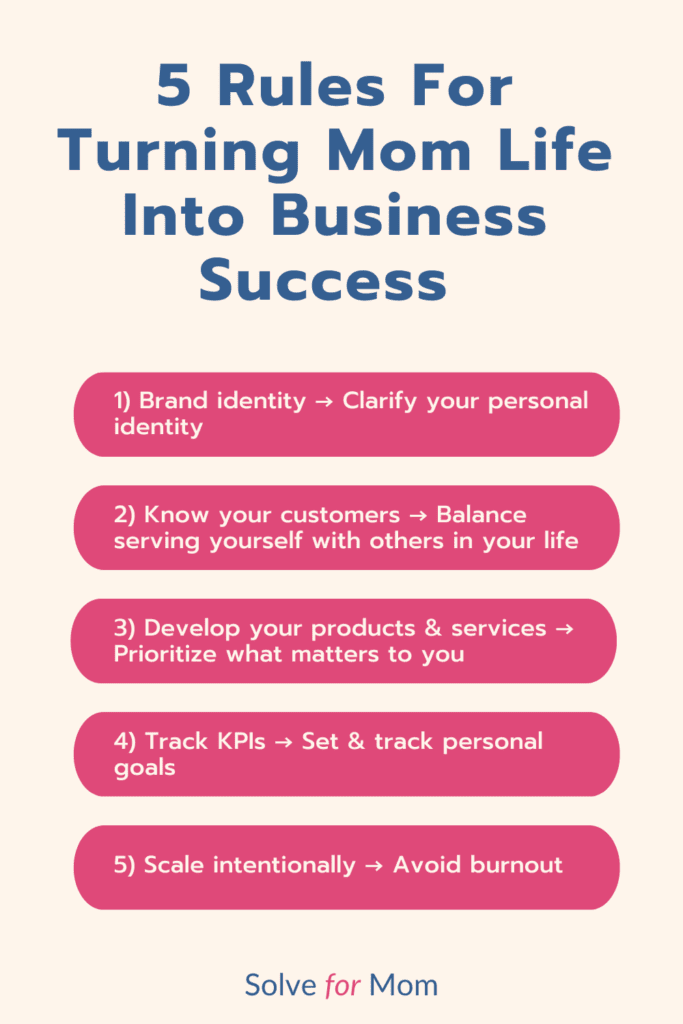
3. Products & services: identify your real priorities (so you stop dropping balls)
A company doesn’t do everything. It chooses its core offers.
Think: one week/month/quarter focuses on one career goal (ex. submit the grant—and not saying yes to every collaboration).
Your life “service lines” are usually things like:
- Parenting
- Career
- Home operations
- Relationship/community
- Self-care/health
This is where you master how to set priorities as a working mom: you decide which career goals and life service lines get investment in this season. That is why I offer tools to clarify and set up decision filters to support your priorities within my Career-Life Integration Protocol ™.
How to prioritize:
- List your goals in each service line.
- Circle the top 1-2 must-win goals this season.
- Pick one thing you will intentionally under-invest in (temporarily, on purpose).
This is one of the fastest ways to reduce decision fatigue because you stop renegotiating your priorities every day.
4. Track KPIs: define success metrics that match your motherhood reality
In STEM, you’re surrounded by metrics: data, publications, approvals. The trap is using these professional metrics for your personal life.
Instead, choose key performance indicators (KPIs) that reflect integration.
- 2 protected deep-work blocks per week
- 3 nights per week with a shutdown ritual (even 10 minutes)
- 1 family anchor (walk, dinner, library trip) that happens weekly
- 1 career goals review each week (15 minutes)
This is also where a weekly planning routine for working moms in STEM is addressed in the time alignment step in CLIP ™.
5. Scale intentionally: avoid burnout by growing at the right time
A CEO doesn’t launch everything at once. They stabilize the core, then expand.
In motherhood + STEM, scaling too early looks like:
- taking on one more research/consulting project
- adding more team members even though you’re capable
- training for new technical skills while working
But capability isn’t the same as sustainability.
Mindful scaling:
- Protect recovery like it’s part of the plan (because it is).
- Before adding something, ask: “What would I have to remove to make this sustainable?”
- Build in a buffer: assume 20–30% of your week will get disrupted (because kids, life, deadlines).
Conclusion
If it feels like you’re failing at work and at home, it’s usually a constraints problem. Without a real integration plan, the default is more context-switching, more guilt, and less deep work—and less presence at home.
The CEO mindset is simply this: you lead your life with intention. You build the roadmap. And you choose what matters—on purpose.
Your next step is small: write the mission statement for this season, then use it to make one decision today. Then you can work through each suggestion in all 5 CEO mindset steps as a woman in STEM.
NEXT STEPS
🔲 Write a 3-sentence mission statement for this season.
☑️ What to do:
- Write: “In this season, I am prioritizing ___.” (choose 1–2 priorities)
- Write: “I will say no (or not now) to so I can protect .”
- Write: “Success this month looks like ___.” (one measurable, realistic outcome)
🔎 What to notice/track:
- Where you feel immediate relief (that’s usually clarity)
- Which decision becomes easier today because of this statement
⭐️ What success looks like by the end of today:
- You make one decision (or say one “no”) faster—without guilt.
Key takeaways for moms in STEM
- If you want to know how to balance career and motherhood in STEM, you need a decision framework.
- Career-life integration works best when you define a season mission and let it drive trade-offs.
- Your CEO operating system is: identity → stakeholders → priorities → metrics → intentional scaling.
- A weekly planning routine matters because it reduces daily renegotiation and protects deep work.
- Tracking 2–4 personal KPIs helps you measure progress in a way that matches real life.
- Serving yourself is not optional—it’s part of system maintenance.
- Burnout prevention isn’t a vibe; it’s a strategy: fewer priorities, more buffers, better boundaries.
FAQs about balancing career and motherhood in STEM
Start by choosing a “season focus” (1–2 priorities) and letting that drive decisions. Use a weekly review to plan around constraints, and build buffers for the disruptions that are normal with kids. The goal is sustainability, not perfection.
Career-life integration is designing your work and home systems so they support each other over time—rather than constantly competing. It acknowledges real constraints (meetings, deadlines, caregiving, limited support) and builds a plan around them.
Reduce the number of daily choices you have to make by pre-deciding your priorities for the week. A short weekly planning routine plus a few “decision rules” (what you say yes/no to) removes repeated mental negotiation.
Yes—if it’s light and flexible. Aim for 15 minutes to set priorities, protect 1–2 deep-work blocks, and identify the week’s “must-haves.” The point is direction, not a perfect schedule.
Treat deep work like a non-negotiable meeting: schedule it, label it, and protect it. Start with just one protected block per week and communicate it clearly at work and at home.
Pick your top two “service lines” for this season (e.g., career stability + family rhythms) and intentionally de-scope something else temporarily. Prioritizing isn’t choosing what matters; it’s choosing what matters most right now.
Have a question? Ask a question or share your thoughts. Your message could be the topic of an upcoming podcast episode!
CONTINUE LEARNING
- How To Reset Your Life To Pursue Your Passion Work With Confidence (Blog)
- Why Planning Is The Key To Time Freedom For Ambitious Moms (Blog)
- How to Measure Success as a Mom (Podcast)
Listen on – APPLE PODCAST | SPOTIFY
Get the Sci-Mom Says Newsletter
If you want more practical and empowering work-life balance strategies, join my free newsletter Sci-Mom Says.
Inside, Sci-Mom Says, you’ll get:
- Career-life integration strategies designed for moms in STEM
- Career decision-making steps
- Workflow designs for moms with high-demanding jobs
