

How to Declutter Your Calendar (The 10% Clean‑Up)
March 23, 2026
In this article
- For moms in STEM, this isn’t just about feeling organized—it’s about protecting deep-work to make career progress without sacrificing family connection.
- Why a cluttered calendar creates more overwhelm (even when it’s full of “good” things)
- The hidden productivity cost of context switching (and why STEM moms feel it sharply)
- Batch blocking vs. time blocking (and when each one helps)
- A simple 5-step calendar clean-up you can do in about 15 minutes
Does your calendar trigger stress before you’ve even started the day?
As a high-achieving mom in STEM, you’re trying to do deep, mentally demanding work in a life that’s broken up by meetings, school logistics, sick days, and the invisible load. The result isn’t just “a busy week.” It’s constant context switching that drains your energy and makes you feel behind.
I recently audited my own calendar and found something surprising: I could reclaim about 10% of my week without working more hours—just by organizing my calendar differently.
Why a cluttered calendar drains your focus
Think of your calendar as a workspace.
Just like you would declutter any other room in the house, we are going to declutter your calendar.
You wouldn’t try to do focused work at a cluttered lab bench or on a chaotic desktop. A cluttered calendar creates the same problem: it makes it harder to think clearly.
And yet many of us—especially working moms—try to operate inside a calendar filled with scattered micro-tasks, reminders, and tiny admin blocks. As a result, even ‘easy’ tasks start to feel heavy.
When your day is chopped into tiny blocks, your brain pays a “switching cost.” Email → writing → scheduling → meeting → back to writing. Even if each task is small, the repeated restarts are exhausting.
Deep work—analysis, writing, experiments, strategy—those restarts hit even harder because deep work needs warm-up time.
You don’t need a prettier calendar. You need fewer mental restarts.
Batch blocking vs. time blocking
Time blocking is assigning a specific time for a specific task.
Batch blocking takes the same idea one step further. You group similar tasks and treat them as a single block of time.
Example: instead of three separate admin blocks scattered across the day, you create one “Admin Batch” block and handle email, expense reports, and paperwork together.
Why this works:
- Fewer calendar entries = less visual overwhelm
- Fewer switches = less cognitive drain
- Same category of work = your brain stays in one mode longer
Batch blocking isn’t about rigidity. It’s about reducing the number of times you have to wind up mentally.
In the Career‑Life Integration Protocol ™ (CLIP), I treat calendar design as resource management—because your attention is one of the first things motherhood fragments.
The 5-step calendar clean-up
Would your calendar this work on a messy Tuesday?
This is a small reset you can do in 15 minutes. You’ll repeat it once a week for a month.
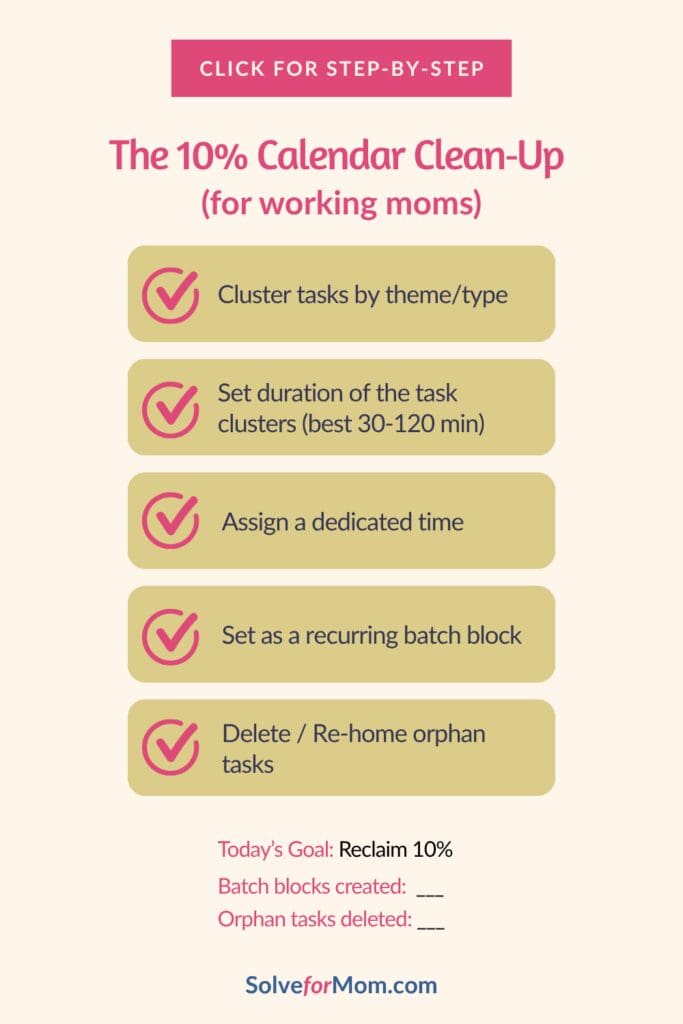
Step 1: Scan for natural clusters
Open your calendar and look for categories that repeat. Examples:
- Admin: email, forms, expense reports, scheduling
- Writing: reports, manuscripts, slide decks, notes
- Home logistics: calls, errands, ordering, school tasks
- Money: bills, budgeting, reimbursements
Step 2: Pick 1–2 clusters and set a realistic duration
Start small. Choose one or two clusters and give each a block that feels doable:
- 30 minutes to 2 hours is the sweet spot for most people
- If it’s too short, you recreate fragmentation
- If it’s too long, you lose focus (or resent it)
Tip: overestimate slightly at first. Buffers reduce stress and protect follow-through.
Step 3: Choose a dedicated time
Decide when this batch should happen. Example:
- Tuesday 9:00–11:00 AM — Admin Batch
- Thursday 1:00–2:00 PM — Planning Batch
If your calendar is meeting-heavy, choose a time that’s realistic, not aspirational. (More on that below.)
Step 4: Make it recurring
Set the recurrence based on real needs:
- Daily (small admin batch)
- Weekly (paperwork, planning, home logistics)
- Twice weekly (if you’re in a high-volume season)
A recurring block reduces decision fatigue because you don’t have to renegotiate the same tasks every week.
Step 5: Delete or re-home “orphan” micro-tasks
Now scan for single-purpose events that don’t belong:
- Reminders disguised as calendar events
- Tiny tasks that could live inside a batch
- Items that aren’t aligned with your priorities anymore
Keep true appointments and meetings as standalone items. But challenge anything that exists only because it’s been there forever.
Your goal this week: create 1–2 batch blocks and remove enough scattered items to free up about 10% of your calendar “surface area.”
Batch blocking is a calendar strategy for full weeks
A common frustration I hear from STEM-trained moms is: “This sounds great, but my calendar is packed.”
If your calendar is packed, don’t batch around an ideal week. Batch around reality. Find a “messy” week and put this strategy to work.
Remember: Constraints aren’t a verdict. They’re inputs.
The point is to create fewer switches and more coherence inside the week you actually have. When your calendar stops fighting your brain, you can make clearer career decisions—because you’re not deciding from exhaustion and fragmentation.
You’re trying to do high-cognition work inside real constraints, without an organizing system that protects your attention. Batch blocking is one small, strategic shift that makes your week feel calmer, more intentional, and more workable—without asking you to “do more.”
Start with one batch block this week. Reclaim 10%. Then repeat.
ONE TIP TO TRY TODAY
🔲 Pick one:
- Create one batch block called “Admin Batch” (30–60 minutes) and move 3 micro-tasks into it.
- Make a weekly “Deep Work Batch” (60–90 minutes) and treat it like an appointment
- Use the first 30 minutes of the day as a “Quick Hits” block (email triage + priorities)
- Delete 3 orphan calendar events that are really reminders (and put them where they belong—task manager, notes, or workflow).
- Add a 10-minute “Buffer Block” between batches so you can transition without whiplash
🔎 What to notice/track:
- How many times you switch modes during the day (a rough estimate is fine)
- Whether your calendar looks calmer when you open it
☑️ What success looks like by the end of today:
You finish the day with at least one new batch block on your calendar and a noticeably less cluttered week view.
Key takeaways for moms in STEM
- Your calendar isn’t just a schedule—it’s a workspace, and clutter creates cognitive load.
- Context switching has a real energy cost; batching reduces the number of mental re-starts.
- Time blocking schedules individual tasks; batch blocking groups similar tasks into one unit.
- You don’t need a full overhaul—start with 1–2 batch blocks and reclaim ~10% this week.
- A recurring batch block reduces decision fatigue and protects follow-through.
- Orphan micro-tasks often belong in a batch (or don’t belong on your calendar at all).
FAQs about calendar management
Start by creating 1–2 batch blocks (like “Admin Batch” or “Planning Batch”), then move scattered micro-tasks into those blocks. Finally, delete calendar events that are reminders. You can see a noticeable difference in 15 minutes.
Time blocking assigns a specific time to a specific task. Task batching groups similar tasks together so you can complete them in one “mode” with fewer context switches. Batch blocking is task batching applied directly to your calendar.
Use low-intensity blocking: create 1–2 batch blocks per week and make them recurring. Keep the time realistic and add small buffer blocks so the system survives disruptions instead of breaking.
Start by clustering similar tasks into one batch (email + paperwork + scheduling) and doing them consecutively. Reduce the number of times you bounce between writing, meetings, admin, and home logistics in the same day. Even one batch block per week lowers switching.
Yes—especially because STEM work often requires deep focus (analysis, writing, experiments, strategy). Batch blocking helps you protect cognitive bandwidth by reducing constant reorientation. It’s one of the simplest ways to make a meeting-heavy week feel more workable.
Remove “orphan” items—tiny tasks that don’t need their own event, reminders that belong in a workflow, or outdated commitments that no longer match your priorities. Keep true appointments and meetings, but simplify everything else.
Have a question? Ask a question or share your thoughts. Your message could be the topic of an upcoming podcast episode!
IF YOU LIKED THIS BLOG
- Rethink the pace and expectations that are filling your schedule in the first place
- Simple science-aware shifts to calm your days
- Life planning framework
Sci-Mom Says newsletter signup
If you want more calm, science-minded strategies for building a life where your career and motherhood actually fit together, join Sci‑Mom Says.
Subscribe here: https://www.solveformom.com/insider
