

5 Realistic Time Management Systems for Moms in STEM Who Need More Time
April 8, 2026
Overview
Here are five STEM-friendly time management fixes that protect your focus and reduce daily friction—so you can reclaim real time.
What You’ll learn
- How to spot “small choices” that silently steal hours (and what to change first)
- Protect deep work: a practical, non-extreme screen-detox approach
- Reduce friction: a daily clutter system that cuts mental load
- Prioritize like a scientist: decision rules that reduce guilt and decision fatigue
- Boundaries under high accountability: a quick “benefit-risk” filter for commitments
Most time-management advice for moms assumes you control your schedule
In STEM, you often don’t. And if you worked years for this expertise, constant interruption can feel identity-eroding—not just annoying.
If your work requires deep focus blocks, heavy documentation, and high accountability—on top of caregiver constraints—then “just wake up earlier” isn’t a strategy.
If you’re nodding along, you’re not alone
Common constraints I see for high-achieving moms in STEM:
- Invisible load at home (planning, tracking, anticipating)
- Unpredictable meetings and shifting priorities
- High-stakes deliverables where mistakes are expensive
- Long focus requirements (deep work) plus constant context switching
Why time management for moms in STEM is different
Most of us think time disappears because of “big” responsibilities. But in my experience, it’s often the small, repeated choices—made on autopilot—that compound into lost hours and stress.
Here’s a tiny example from my house: we have a narrow storage closet with bins and labels. When I’m rushed, I still toss mail, markers, or a book in there “for now.”
Even small choices can have a cumulative effect.
That choice feels harmless. But repeated all week, it turns into time lost—hunting for things, carrying mental clutter, and eventually doing a bigger cleanup.
The choices you repeat become the system you live in.
Try it like an experiment:
- Treat your week like an experiment.
- Identify one repeating “small choice” that creates downstream cleanup.
- Change just that variable for 7 days (not your whole life).
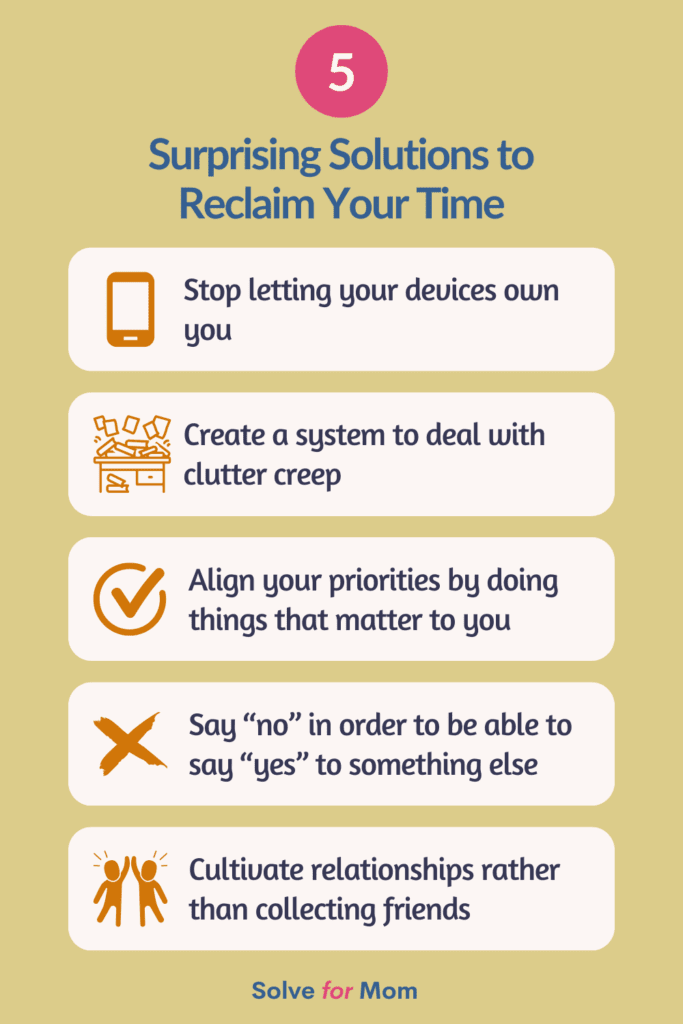
Fix #1: Protect deep work (tech use reframe)
I say this with zero judgment: my phone is a constant temptation—especially on tired days.
Your phone is designed to pull you in. The goal isn’t “never use your phone.” It’s to make it easier to stay focused when you actually need deep work.
Start with one:
- Create “parking spots” for your phone (one per floor, or one per work zone) so it’s accessible but not attached to you
- Use airplane mode during focus blocks and during sleep
- Make meals device-free (I do this because dinner time is family time)
- Do a mini screen detox: remove one app from your home screen for a week (still accessible, but friction-added)
If you’re a PhD scientist navigating tenure-clock pressure or managing experiments that require long attention blocks, this one change alone can protect your cognitive energy—not just your minutes.
Technology is supposed to be working for us. We use it, not the other way around.
Fix #2: Reduce workflow friction with a daily system to stop clutter creep
Disorganization creeps up on you. And when your environment is chaotic, you don’t just lose time—you lose clarity.
Clutter creates friction. Friction steals time—and it also steals clarity.
The solution isn’t a perfect weekend reset. It’s a daily workflow that’s small enough to sustain.
My simple system:
- Keep a tote bag (a grocery bag works) for “things that belong elsewhere”
- As you move through the day, drop items in the bag instead of relocating them to a doom-pile
- At the end of the day, do one final sweep and put items away properly
Then the multiplier: support from the people who live with you. In my house, my kids have specific responsibilities—clothes, toys, cleaning up one activity before the next, helping with the kitchen. Teaching kids life skills isn’t just good parenting; it’s time management.
What to try this week:
- Choose one repeatable “put away” moment (after dinner, before bedtime)
- Assign one age-appropriate task to each child (or one shared “reset” task)
- Keep it consistent, not perfect
Fix #3: Prioritize like a scientist by using life planning to reduce decision fatigue
One of the biggest time traps is spending energy on things that don’t matter to you—because you haven’t defined what does.
You can’t treat everything as equal importance. That’s not a time problem; that’s a priority problem.
This is why I’m such a believer in life planning. It gives you a decision-making framework—so you can prioritize without constantly negotiating with guilt.
These systems aren’t just about saving minutes. They’re about feeling like one whole, integrated person again—not a scientist at work and a different person at home.
Some grounding questions to ask (write your answers, don’t just think them):
- What do I value most in this season?
- Who do I want to have real time for?
- What are my goals right now (not “someday” goals)?
- What kind of life am I building—one year from now, ten years from now?
This isn’t about being morbid. It’s about being intentional—so life doesn’t just happen to you.
Fix #4: Establish boundaries with a “benefit-risk” filter to protect your time
Here’s a reframe I love: when you say yes to one thing, you’re also saying no to something else. The opposite is also true. A no is a vote for something else—often your health, your family time, or your deepest goals.
Since your time is limited, you want to be sure that you’re mostly spending it on things that matter most to you.
To decide what gets your yes, I use a quick filter you’ll appreciate if you’re STEM-trained: a mini benefit-risk assessment.
Ask:
- Is this activity providing value?
- How long will it take—really?
- Will it disrupt the rhythm of my day/week?
- If I say no, what’s the real downside?
- If it must be done, can I delegate it (to a partner, a coworker, or yes—sometimes to kids)?
Fix #5: Invest in high-ROI relationships
Your relationships affect your time, too—because some connections restore you, and some leave you depleted.
A quick filter: after you spend time with this person, do you feel steadier—or more drained?
This week, invest in one high-ROI relationship: schedule one call, one walk, or one coffee with someone who makes you feel supported.
Conclusion
If you’ve been telling yourself you’re “bad at time management,” I want to challenge that. You’re not failing—you’re operating inside real constraints without an integrated plan and without systems that protect your time.
Pick one fix from this episode and run it like an experiment this week. One change, repeated, is how you build a schedule that actually supports both your career and your family life.
ONE TIP TO TRY TODAY
☑️ What to do:
- Set a 10-minute timer and list the top 3 places you’re losing time right now (devices, clutter, misaligned priorities, over-yes’ing, draining relationships).
- Circle one that feels most “fixable” today.
- Choose one micro-action.
Examples:
- Put your phone on airplane mode for a 30-minute focus block (or during dinner)
- Start a clutter tote bag and do a 3-minute end-of-day put-away
- Write one boundary “no” you need this week (and what you’re saying yes to instead)
🔎 What to notice/track:
- How much mental bandwidth did you get back (focus, calm, fewer repeated decisions)?
- What resistance came up (guilt, fear of missing something, discomfort)?
- What success looks like by the end of today
Example: You took yourself off autopilot in one area and reclaimed a small, real pocket of time you can repeat tomorrow.
⭐️ What success looks like by the end of today:
- You reclaimed one small, repeatable pocket of focus time (15–30 minutes) and feel noticeably calmer about tomorrow.
Key takeaways for moms in STEM
- Time management for moms in STEM isn’t about doing more—it’s about removing friction and protecting cognitive energy.
- Small “harmless” choices compound into big time losses over weeks and months.
- A healthier relationship with your phone can return time fast—without needing perfection.
- Daily clutter systems beat occasional deep cleans (and reduce mental load).
- Life planning creates a prioritization framework so you stop spending time on what doesn’t matter.
- Boundaries are a strategy: a no is a vote for your real priorities.
- Curate relationships that feel like support, not another drain on time and energy.
FAQs about time management as a scientist
The best method is the one that fits your constraints. Start by identifying your biggest time leak (devices, clutter, priorities, overcommitting) and implement one small system you can repeat daily.
Focus on decision rules and boundaries, not perfect scheduling. Use short “benefit-risk” filters for commitments and protect 1–2 non-negotiable anchors (like sleep, dinner, or a focus block).
Treat focus like a scarce resource: reduce context switching, add friction to distractions (airplane mode, app removal, phone parking spots), and schedule at least one protected focus block a few times a week.
Add friction: phone parking spots, airplane mode during focus/sleep, and device-free meals. You don’t need to quit your phone—you need it to serve you.
Yes, but start even smaller. Choose one micro-system that reduces repeated effort (like a tote-bag clutter sweep) and one boundary that prevents a time spiral.
Is time management for moms in STEM different from general time management advice?
Often, yes—because STEM roles can demand deep work, documentation, and high accountability, while parenting adds invisible load. You need systems that protect focus and reduce decision fatigue, not just “do more.”
Have a question? Ask a question or share your thoughts. Your message could be the topic of an upcoming podcast episode!
IF YOU LIKED THIS BLOG
- How to Get Unstuck as a Scientist Mom (Blog)
- How to Declutter Your Calendar (The 10% Clean-Up) (Blog)
- How I time-block in real life (Podcast)
Listen on – APPLE PODCAST | SPOTIFY
Sci-Mom Says newsletter signup
If you want grounded, STEM-friendly frameworks to help you reclaim time without sacrificing your career or your family life, join my free newsletter Sci-Mom Says.
Inside Sci-Mom Says, you’ll get:
- Decision frameworks for time management in demanding STEM seasons
- Practical systems that reduce invisible load (not “add one more thing”)
- Weekly reminders that help you protect what matters—without guilt
Subscribe here: https://www.solveformom.com/insider
