

How women in STEM can set boundaries and still get paid more
May 27, 2026
Overview
Get paid more as a woman in STEM by identifying where you’re over-functioning and then choosing one area to reset—pay, scope, or flexibility—so your compensation matches your responsibility without draining your time and energy. I sat down with Sarah Walton—business coach, wealth advocate, and host of The Game On Girlfriend Podcast—to better understand our relationship as women with money, time, and value.

What we discussed:
- Why high-achieving women often end up under-earning and over-functioning
- The hidden problem behind over-delivering (and how to break it)
- Earn your worth by turning apology reflex into clear statements
- An introduction to wealth consciousness and money mindset for women
- A practical take on negotiating pay, scope, and flexibility at work
- How to escape either/or thinking by finding the third door
Does your pay match your time and energy?
If you’re a high-achieving mom in STEM, you’ve felt the disorienting mismatch: you’re producing high-quality work, you’re carrying the invisible load at home, and yet your pay (and sometimes your recognition) doesn’t reflect how much you’re actually holding. You’re doing everything “right” and still falling behind—financially, energetically, or both.
STEM culture wasn’t built for caregivers. So even when you’re brilliant at your job, the system can push you into over-delivering, over-explaining, and apologizing for needs that are completely normal (like pickup, a sick kid, or protected focus time).
I sat down with wealth advocate Sarah Walton to name the pattern underneath under-earning—and to give you language and a plan that actually fits real life as a working mom.
A reality check: the hidden value of caregiving labor
Sarah shared a money stat that adds perspective to this conversation:
“The average across the United States of America, the average housewife, we are talking a human being who does not have an outside job, a human being who is raising the next generation, doing laundry, running errands, preparing meals, meal planning, doing the grocery shopping, making the doctor’s appointments. We all know how endless this list is, right? That the average human being doing that work is worth $175,000 to the family every year. And isn’t it interesting that we as women have all bought into the idea that that doesn’t count?”
Sarah Walton, Episode 117 on Science Careers for Moms
Then came the gut-punch question: Are you paying to work?
This interview is about a different way to think about getting paid more. Not by pushing harder, staying later, or “proving” yourself through endless over-delivery—but by raising your standards, setting cleaner boundaries, and making direct asks that match the reality of your life. The goal is getting paid more without it costing your health, your time, or your presence with your family.
How over-functioning keeps women underpaid (especially in STEM)
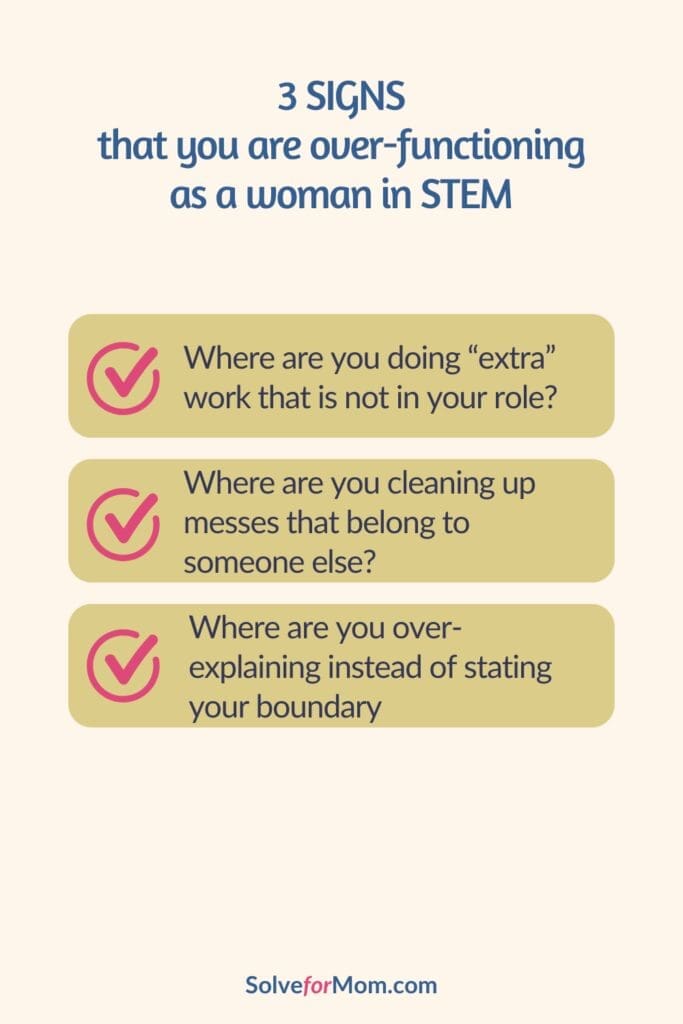
Sarah uses a term that landed hard for me: over-functioning—the habit of doing extra, managing everyone else’s comfort, and absorbing problems that were never yours to carry.
High-functioning codependence
Sarah named the deeper pattern behind chronic over-delivering: high-functioning codependence. This is a concept introduced by psychologist Terri Cole in her book Boundary Boss. It’s when you’re capable, competent, and high-performing on the outside—but internally, your sense of self is still tethered to whether other people are comfortable, impressed, or happy with you.
In other words, it’s not just that you’re doing extra work. It’s that you’re often doing extra work to manage the room—to avoid disappointment, prevent conflict, or earn the good employee gold star.
Why moms in STEM are especially vulnerable to over-functioning
In the episode, Sarah points out that this pattern often starts young: we learn to put other people’s comfort ahead of our needs: “Don’t cry.” “Give me a smile.” “Be helpful.” Over time, that conditioning can become a professional identity: the person who anticipates everything, fixes everything, and never needs anything.
It’s easy to miss because over-functioning often looks like competence: you anticipate problems, you fill gaps before anyone asks, you keep things moving, and you quietly make the system work.
Especially in STEM environments, where being reliable gets rewarded—until the reward turns into an expectation: more output, more responsibility, more emotional labor… with the same pay. Over time, over-functioning teaches the people around you a subtle (but costly) lesson: “She’ll handle it.” And when that becomes your brand, your workload expands faster than your compensation.
In STEM roles (research, engineering, biotech, data, health tech), over-functioning can look professional on the surface:
- you’re reliable
- you’re high-integrity
- you catch mistakes before anyone else sees them
- you fill gaps because you can’t tolerate sloppy systems
But over time, it quietly trains people to expect more from you for the same compensation.
Signs that you are over-functioning:
- Where are you doing “extra” work that is not in your role?
- Where are you cleaning up messes that belong to someone else?
- Where are you over-explaining instead of stating your boundary?
If you can name the pattern, you can change it.
Sarah’s grocery store story (and why it changes how you ask for more)
Sarah shares a story that sounds simple on the surface—standing in a grocery store—but it points to something a lot of high-achieving moms in STEM don’t notice until they’re exhausted: we can be “successful” and still feel like we’re constantly bracing. Not because we’re doing anything wrong, but because we’re operating under an invisible rule that says the system gets to take whatever it wants from our time and energy, and we’ll figure out the rest at home.
In Sarah’s words: 🎧 Jump to Sarah’s Grocery Store Story
What I want you to hear in this story is the shift: the moment you realize you’re not just negotiating salary—you’re negotiating terms. When you start treating your time and energy as part of the compensation conversation, you stop asking from guilt and start asking from clarity. And that’s when “get paid more” becomes a whole-life decision, not just a number.
The Apology Reflex undervalues moms in science & tech
We also talk about how caregiving is culturally minimized, even though it’s real labor with real value—and how that belief can seep into how moms show up at work. When the world treats caregiving like “less than,” it’s easy to start acting as if your constraints need justification, or as if your needs are an inconvenience you should soften with extra niceness.
That’s where the “apology reflex” shows up: over-explaining a boundary, adding unnecessary personal details, or apologizing for normal realities like pickup, a sick kid, or needing protected focus time.
“We don’t apologize anymore. We say, ‘I’ve got to go.’ You don’t have to say why. It’s none of their business.“
Sarah Walton, Episode 117 on Science Careers for Moms
One of the simplest boundary upgrades Sarah offers is also one of the most powerful: stop apologizing for being a parent. A clean line like “I’ve got to go” is enough. No justification. No negotiation. Just clarity.

The Over-Giver Tax prevents you from getting paid more
The Over-Giver Tax is what happens when you consistently do work that’s outside the agreement—then treat it as “just being helpful.”
“Stop training people to underpay you.“
Sarah Walton, Episode 117 on Science Careers for Moms
This Over-Giver Tax is expensive. If no one can see the additional scope, there’s nothing to renegotiate. The practical move here isn’t to stop being excellent—it’s to stop letting excellence automatically become free labor.
For women in STEM, that renegotiation usually lands in one of three places: reduce scope, raise pay, or reset the expectation. The power is in calm, direct language that brings the real agreement back onto the table.
“Just do your job, show up, send the invoice to the universe.“
Sarah Walton, Episode 117 on Science Careers for Moms
Sarah’s corporate moment – how to advocate to get paid more while setting boundaries
A theme in this conversation is escaping forced-choice thinking: career or family, impact or rest, money or integrity.
In her story, Sarah shares how she rose up in her corporate career—and the moment she realized that her 16-year-old self was still running her life. The expired narrative was: “I can’t take care of myself and my family at the same time.”
“These years fly by so fast. And not one of us looks back and says, ‘Yeah, but I wish I had made that marketing meeting.’ …Nobody, nobody thinks that. And so to do that to ourselves in the moment is such a disservice.”
Sarah Walton, Episode 117 on Science Careers for Moms
Her turning point is a reminder that “success on paper” can still be misaligned. And that you’re allowed to redesign the model—even if you’ve invested years in becoming the person who can handle anything.
The mindset shift that unlocks the third door
Sarah calls it looking for the third door—the option you can’t see when you’re trapped in either/or.
For a lot of moms in STEM, the shift isn’t quitting or burning it all down. It’s recognizing the hidden rules you’ve been living by, and choosing a new definition of success that includes your health, your family, and your capacity.
A lot of working moms in STEM feel stuck in a forced choice: If I set boundaries, I’ll look less committed. Or: If I push for more pay, I’ll be punished with more work. Sarah calls this the trap of either/or—and her reframe is to look for the “third door,” the option you can’t see when you’re only debating between two bad choices.
Wealth for women in STEM is not just about money
Sarah’s definition of wealth consciousness widens the conversation beyond income.
She’s talking about wealth in health, relationships, presence, and the feeling of being able to live your life—without your job taking everything good first and leaving you the scraps.
“Wealth consciousness doesn’t always mean money. I’m talking about wealth in love, wealth in health, wealth in relationships, wealth in life, wealth in living.”
Sarah Walton, Episode 117 on Science Careers for Moms
That matters for moms in STEM because many of us have been trained to treat depletion as the price of being “serious” about our careers. Wealth consciousness is what keeps you from winning on paper while losing at home.
That’s the point: getting paid more isn’t just a number. It’s about understanding the impact your career decisions have on other parts of your life. Your salary is feedback for alignment.

Infinite money and how it relates to your time
Sarah makes a distinction that’s especially important when you’re parenting: time is finite. Money can expand. And if you don’t clarify that relationship for yourself, it’s easy to fall into the default strategy of trying to earn more by doing more—more hours, more output, more availability—until you’re running on fumes.
Time is finite, but money is infinite.
Time has a hard ceiling—especially when you’re parenting. Money, on the other hand, doesn’t lose value no matter how many hands touch it. Money gives you back your time, And money can expand when you solve problems faster and better.
For moms in STEM, this is a deep permission slip. In many cases, working more hours is exactly what breaks you. The more sustainable path is setting cleaner terms for your work, using leverage, and making aligned decisions—so your compensation matches your contribution without requiring your life to shrink.
That’s how you get paid more without sacrificing time and energy: you stop treating time as unlimited, and you start treating sustainability as part of the job.
Negotiation tactic: “time travel” into future-you clarity
☑️ What to do:
- Complete Sarah’s Freedom Calculator.
- Do Sarah’s “time travel” step:
- Picture yourself 6 months from now saying, “I nailed it. I’m earning more and protecting my time and energy.”
- Ask that future version of you: What did I do first to get here?
- Write the answer as one sentence that starts with: “This week I will…”
🔎 What to notice/track:
- Where you feel pulled into the forced-choice trap (earn more or be present at home).
- Whether your “first step” is a pay ask, scope reset, or flexibility boundary.
⭐️ What success looks like by tonight:
- You have one concrete next step that a future-you would thank you for. Remember, you’re not trying to do it all—you’re turning your ideal life into your real life.
Conclusion
If you’re failing both—career and motherhood—there’s a good chance you’re not failing. You’re operating inside real constraints without an integrated plan for pay, scope, and flexibility.
Start small: name one place you’re over-functioning, choose one lever, and make one clean ask. You don’t need a full reinvention. You need a more truthful operating system.
And if you know another mom in STEM who’s “doing everything right” and still feels underpaid and exhausted—share this episode with them. It’s a conversation worth having out loud.
Key takeaways about how to earn what you’re worth in STEM
- Under-earning is often tied to over-functioning, not lack of skill.
- “Selfless” praise can be a trap when it rewards you for not having a sense of self.
- For moms in STEM, pay / scope / flexibility is the most practical negotiation lens.
- A clean boundary can be one sentence: “I’ve got to go.”
- Stop over-explaining: your caregiving constraints are real, and you’re allowed to design around them.
- Look for the third door—the option beyond “career vs family.”
- Alignment matters: the “cost” isn’t only money; it’s time, energy, and presence.
- One clean ask this week is more powerful than another month of resentment.
FAQs about getting paid more as a mom in science
Start by identifying where you’re doing unpaid “extra” work (scope creep). Then choose one lever—pay, scope, or flexibility—and make a clean ask that protects capacity.
Anchor your ask to outcomes, scope, and responsibility. If your role expanded, name the expansion clearly and ask for compensation that matches the new scope.
A complete sentence can be enough: “I’ve got to go.” You don’t have to explain childcare logistics to be professional
Replace “managing other people’s comfort” with “staying on assignment.” Do excellent work, keep integrity, and stop overstepping into outcomes that aren’t yours to control.
Often yes—but it works best when framed as a sustainability strategy tied to performance (e.g., protected deep work time, predictable pickup windows, reduced low-value meetings).
That fear is common—especially in cultures not built for caregivers. Start with one small boundary, delivered calmly, and track the result. Most of the time, clarity increases respect.
Have a question? Ask a question or share your thoughts. Your message could be the topic of an upcoming podcast episode!
Listen to the interview with Sarah Walton
Listen on: APPLE PODCAST | SPOTIFY | YOUTUBE | AMAZON MUSIC
Episode highlights
- (0:00): Teaser & Introduction
- (4:45): Why high-achieving women end up under-earning + over-functioning
- (6:11): High Functioning Codependence and the conditioning behind people-pleasing
- (14:36): The hidden cost of being praised as “selfless”
- (16:35): Stop apologizing (and stop managing other people’s reactions)
- (18:50): Finding the “third door”
- (20:07): Sarah’s famous Grocery Store story
- (32:12): The Over-Giver Tax and how to reset standards without guilt
- (38:27): Money is feedback for alignment (congruence between love and compensation)
- (39:30): Sarah on Wealth Consciousness
- (43:05): Clarifying the relationship between money and time
- (45:43): A simple approach to getting your ideal pay, role, or job flexibility
Prefer to read? Here’s the transcript
0:00:00 — Introduction
Sarah Walton: The average across the United States—the average housewife, meaning a person who does not have an outside job but is raising the next generation, doing laundry, running errands, preparing meals, meal planning, grocery shopping, and making doctor’s appointments—we all know how endless this list is. The average person doing that work is worth $175,000 to the family every year. Every year. That is what that work is worth. And isn’t it interesting that we as women have all bought into the idea that that doesn’t count?
Anokhi Kapasi: Hi, and welcome to Episode 117 of Science Careers for Moms. I’m your host, Anokhi Kapasi. This is the show for high-achieving moms in STEM who feel torn between being a serious scientist and wanting to be a present mom. On this show, you’ll learn how to make confident career decisions without sacrificing the other parts of yourself.
Have you ever had that gut-punch moment where you realize you’re doing everything right, but you still feel exhausted and somehow underpaid? Or worse, you’re actually paying to work—with your time, money, energy, and peace.
Today, I’m joined by Sarah Walton, a wealth consciousness coach, pay advocate, and host of The Game On Girlfriend Podcast. She focuses on putting more money in the hands of more women. This episode is your permission slip to stop over-giving at work, because Sarah gives us the language for the moments when we need it most—so we can stop negotiating against ourselves and start advocating for better pay in a way that actually works with life as a mom.
In this conversation, we talk about how to stop the apology reflex and find the power within us to start saying yes or no when we want to.
This episode is full of entertaining and moving stories, including Sarah’s famous grocery store story and one of her powerful moments in corporate. I also learned new terms that clarify so much, like the over-giver tax, wealth consciousness—which, spoiler alert, is not all about money—and what infinite money is. This is a really fun one, and there are so many golden nuggets in this conversation that you’ll definitely want to listen to the end. All right, here we go.
Welcome to Science Careers for Moms, the podcast for women in STEM who want to have both a meaningful career and be there for the important things in life. Hi, I’m Anokhi Kapasi, a PhD researcher, business owner, and homeschooling mom of two boys. I’m passionate about helping moms in science and tech build careers that fit their whole life. Join me for honest conversations with other scientists who’ve gone through the same career decisions you’re facing right now. You’ll also get actionable frameworks that cut through burnout, work-life balance myths, and circular decision-making. If you’re ready to make STEM career decisions that let you be an amazing mom, you’re in the right place. Let’s get into today’s episode.
I am thrilled to introduce Sarah Walton as today’s special guest. Sarah is the coach women call when they’re done with people-pleasing and pretending they’re not ready. Her clients are often the most credentialed women in their workplace, including women in STEM who’ve spent years proving their worth and still aren’t charging for it. Sarah Walton is the host of The Game On Girlfriend Podcast, a show that helps high-achieving women advocate for pay, scope, flexibility, and visibility in high-pressure cultures. So, Sarah, is there anything you want to add to that or correct?
Sarah Walton: No, that was perfect. First, I’m just so happy to be here. There are so many women who are absolutely amazing. Because of our conditioning—the lives we’ve had, and the experiences we’ve had—we kind of forget how awesome we are. So I’m here to remind us all that we’re pretty freaking great.
Anokhi Kapasi: Amen to that. That is definitely a message I can get behind. I think we each have our own specialties, but there’s a lot of overlap, and that is definitely one of them.
Sarah Walton: For sure.
Anokhi Kapasi: For sure.
Anokhi Kapasi: Well, Sarah, you work really closely with high-achieving women beyond science and tech. Obviously, I focus on helping a lot of women in science and tech, but I would say that most women in STEM would probably classify themselves as high-achieving women. They’re also highly credentialed, and I think that comes with a really strong work ethic. There’s a certain mindset that comes with that kind of work, and I believe that is the key to our success. It’s gotten us to this point, especially in science and tech fields, where over-delivery, attention to detail, and a focus on high quality are really important skills to have.
0:06:03 — Over-Functioning Explained
Sarah Walton: Yeah—that is the word: over-functioning. There’s actually a phrase coined by psychologist Terri Cole, who wrote a book called Boundary Boss. I don’t love the title, but the book is fantastic. The concept she really shares is called high-functioning codependence, and it’s that codependence piece that I think can really trip us up. It shows up in everything we do.
So what does that mean? This codependence starts when we’re really young—when we’re conditioned to put our needs second. It can be anything from “Where’s that pretty smile?” when we’re upset as little girls, or “Don’t cry.” Those little things add up over time, and we start to learn that what we feel, think, and know isn’t as important as other people’s comfort. The more we make other people comfortable—usually by over-functioning or over-delivering—the more we’re rewarded.
And the rub is that this conditioning often comes from other women too. You see the woman who’s running around like crazy—doing parent-teacher stuff, making lunches, sitting in the car line, running a business, taking care of the kids, and being a great wife—and everyone says, “Oh my God, she’s so selfless.” What a horrible phrase. We’re giving accolades to people for not having a sense of self. But that’s exactly what gets rewarded, and it creates codependence in us.
We want to be the person others talk about like that. We want to be the one everyone says is amazing. So we buy into it and become codependent on the accolades of clients, bosses, peers—even our own children. It becomes a vicious cycle where we don’t feel okay until someone outside us says, “You’re doing great.” And then we’re only okay for a little while, so we over-function again to get that validation back.
This is where the spiritual piece comes in for me. Whether you believe in God, a higher power, or the universe, I think this philosophy helps women break that codependence. The idea is that you’re here on this planet to fulfill your soul contract—your agreement with the universe, whatever you want to call it. That’s it. If your gift is making people laugh, maybe you’re here to spread joy; if your gift is seeing solutions other people miss, that’s what you’re here to do.
And your only job is to keep that agreement. And the beautiful part of that is it usually brings us joy.
And then what I’d like to say is: you stay on assignment, you keep your agreement with the universe, and then you send the invoice to the universe. You’re like, “Listen, I’m doing my job—the rest of it’s up to you.”
And that way, if you show up for a client, you do your job. You do what you’re here to do. The rest of it is none of your business.
We are way overstepping. We do it with our children, like they can’t possibly fail. And it’s like, no, no, no—if a child doesn’t fall when they’re learning how to walk, they don’t learn how to walk. You have to let them fail. It’s part of the growth process, right?
So we don’t want to overstep because of this codependence. Instead, we constantly look at us and go: “Am I keeping my agreement with the universe? Am I showing up as me? Am I using the gifts I was given? Am I on assignment?” Outside of that, you have no other work.
So if you can continue to bring yourself home and be like, “Was I the most loving today? Am I really proud of who I was?” the rest of it doesn’t matter. The rest of it—you send the invoice to the universe.
What I love about that is there’s so many women who are so talented and so great, especially in their own businesses, and they’re like, “Oh, but I have to charge for this,” or “I’m scared to charge for whatever.”
Don’t even worry about that. Just do your job, show up, send the invoice to the universe.
And I’m not saying don’t charge people. What I’m saying is: the emotional, the financial, the physical—the toil, the struggle—that’s not your job. Your job is to show up and do your job.
And part of that means slow mornings. Like, take a beat in the morning. Not pick up your phone. That’s not serving you. That’s the rest of the world telling you what it wants from you.
This coming home moment that we need so badly every day, we’ve just given up, right? And I think that’s part of the soul contract—to come home every day, every morning. “What would make today amazing? What is my job today? What do I need today?” And actually giving ourselves the moments to find that.
And that’s when we get inspired to take the action. That’s when all of a sudden it’s like, “Actually, I’m going to charge $10,000 for that project, not five,” because you’re clear—because you are on assignment.
All of a sudden it gets crystal clear, and then you send the invoice for the correct amount—meaning it matches. It’s congruent with the work that you’re providing, because you’re in such a clear, beautiful space.
So we can operate from that, instead of: “Am I okay yet? Do you like what I’m doing? Is this okay? Are you mad?” All of a sudden we don’t have to worry about that because that’s the universe’s job. That’s God’s job to deal with all of that.
That’s way overstepping on our part, right? Like that’s not our business. Our business is to show up as the best version of ourselves.
So I hope I answered your question about why we over-function and how we can work on that.
Anokhi Kapasi: Yeah. No, that was great. I am understanding from what you said that it really is getting clarity about what your version of success is and not operating off of other people’s definition, and understanding what your purpose is, and being authentic to who you are, and what you want.
We keep getting these messages—the societal messages—like you said, that women, moms are supposed to be selfless, and I think that those do a disservice to us. And what you just described was a reframe. So it was the why and also a little bit of how to move forward past that. So that was great.
I come from the world of science and tech, so it’s pervasive—this issue of over-functioning—and often being sidelined, especially once you become a mom. And I was just wondering if it was specific to the science and tech world, or if this is something that high-achieving women in general experience. And it sounds like this extends beyond just a specific kind of career.
Sarah Walton: Yeah. It’s all of us, and it’s in so many different facets of our lives, especially once we become moms. It’s literally in every facet of our lives. We’ve been trained—conditioned—to make sure everyone else is taken care of first.
Anokhi Kapasi: Yeah.
Sarah Walton: To our detriment.
Anokhi Kapasi: Maybe some of that’s biology that kicks in when you become a mom. You’re adding more of that care and responsibility, and the stakes are high. You’re raising kids to become capable people in the world.
What I find interesting—and I think this is the crux of what I end up working on—is that as high-achieving women, we generally probably are a little more attuned to operating this way like you described. We fall prey to these messages, and when you become a mom, it’s often at that inflection point in that upswing of our career.
We’re often career-oriented for a good early part of our lives, and we maybe even put off having families, and then we become moms at that point where we probably feel, to ourselves at least, that we’ve earned that flexibility—maybe being able to charge more, having more authority in the work that we do.
And once we become moms, it’s almost like we start becoming apologetic, like, “Oh, now I’m a mom, so yeah, I’m sorry, I have to X, Y, or Z.” And it’s like all those years and training that we put in don’t even count for anything—and so we give even more. We undervalue ourselves even more.
I hope no one hears this and thinks the message is motherhood is some sort of penalty. I believe it’s like the best experience—the most important job I’ve ever had, if you can call it a job. So that is not at all what I’m saying. But I think that everything you’re saying has even more weight to the mom version of us.
0:14:37 — Motherhood Undervalued
Sarah Walton: Yes. I couldn’t agree more. And I think—what an interesting thing in our society, right? What an interesting thing that raising the next generation of human beings doesn’t matter.
I mean, it is a job. Of course it’s a job. It’s a full-time job.
The average across the United States of America—the average housewife—we are talking a human being who does not have an outside job, a human being who is raising the next generation, doing laundry, running errands, preparing meals, meal planning, doing the grocery shopping, making the doctor’s appointments—we all know how endless this list is, right?
The average human being doing that work is worth $175,000 to the family every year. Every year. That is what that work is worth.
And isn’t it interesting that we as women have all bought into the idea that that doesn’t count? It does count.
If you were to disappear tomorrow, your family has to come up with $175,000 a year to replace you. That’s real. That’s financial.
That’s not even the emotional work—all the other stuff that we do: the lesson teaching, the morals, the reading, all those other things. There is so much in that. And that we have all bought into the idea that it doesn’t count is fascinating to me.
And I think that’s something I really want to fight for all of us for, is: let’s question that. Let’s just take a minute and wonder how much of that we’ve internalized. How much do we believe it doesn’t really count?
Because there’s not a job description somewhere—how much do we think that doesn’t really count because you can’t put it on Indeed, or wherever the heck you want to put it, right? That is not accurate.
And I’m really out to have us start to question that because it will be up to women, for each other, to redefine that.
Now, if that is what someone chooses to do with their life—our next generation thanks you so much because it is invaluable work. And right now, we’ve seen the result of a lot of world leaders who weren’t parented, right? That’s a problem. It causes a massive problem and everyone pays the price. So I really want to work to reframe that.
And for any woman listening who said, “Oh my gosh, I just apologized yesterday because little Timmy was sick and I had to go,” like whatever—we don’t apologize anymore. We say, “I’ve got to go.” You don’t have to say why. It’s none of their business, right?
Again, that’s the overreaching. And I know I sound angry as I say this, but it’s because it’s so important to me that it lands. I’m actually not angry.
I’m adamant that we understand what has been in this conditioning and how damaging it is. And it’s not okay. It’s absolutely not okay.
And it’s gonna be up to us to pick up the mantle and say, “I’m gonna need to leave today at two.” Zero explanation. There’s no explanation needed. It’s no one’s business.
You are an adult, and they’ve hired you to be an employee—which means they trust you to make decisions for yourself in your life—and it’s none of their business what those decisions are.
And once we can start to own the power of that, all of this angst around apologizing can go away. And the amount of energy that’s available to us when we aren’t worried about that—oh my gosh, it’s so great. All of a sudden, you can perform higher and it wasn’t even hard.
Anokhi Kapasi: Right.
Sarah Walton: Joy being with your children instead of being worried about work and feeling guilty. And then when you’re at work, you feel guilty about the kids.
All of a sudden, that can start to dissipate because you refuse to buy into—it is a false narrative—that that $175,000 a year job doesn’t quote-unquote count. Oh, and PS: it’s a job you’re doing while you’re doing other jobs.
So critical. And you get to own that. You get to own that and say, “Not only am I not going to over-function around this, I’m not going to apologize for it either.”
I’m just going to do it and y’all can watch. And every time there’s a woman who does that, we are silently giving permission to other women to do the same.
And I’m always so moved when I see a woman who says, “No, sorry, I can’t make that,” and then stops talking. I get so excited. I’m like, “There she is. There’s the power. There’s the ownership.”
She knows she’s on task. She knows she’s on assignment and she’s doing her job. The rest of it’s none of her business.
And the freedom that comes from that, and the joy that comes from that, and living your own life again without exhaustion is so beautiful.
And so that’s why I get so adamant: I want every woman on planet Earth to feel that joy.
These years fly by. My kids are now 16 and 19, right? These years fly by so fast.
And not one of us— not one of us—looks back and says, “Yeah, but I wish I had made that marketing meeting.” Or, “Yeah, I really wish I’d put in an extra two hours on that one thing I was working on.” Nobody. Nobody thinks that.
And so to do that to ourselves in the moment is such a disservice. I really want other women to hear me and go, “I’m going to try this out and see what happens.”
Let’s see what happens when you don’t overreach or try to control what everybody else is thinking—because it’s not your job.
Anokhi Kapasi: Yeah, exactly. The world of science and tech—the culture—it really wasn’t designed for caregivers. And so to sit there and try to change the system… I mean, sure, there is some policy work and things that can be done.
But what I like about what you’re saying is, instead of sitting in that sort of sense of victimhood, there is something you can do. You can put yourself in that driver’s seat and say, “Hey, I’m going to change. I can’t change the system necessarily, but I will change the way I’m going to operate within this system.”
And I think that that is definitely useful advice that we can take on, especially in really high-demanding knowledge work fields.
And so, I was wondering if this is something that you experienced. Was there a moment in your career where maybe you realized that you were making decisions that were operating against who you are or what you wanted? And what was your experience? Is that kind of what fueled the work that you do? And if you came to any realizations, what changed after that?
0:20:30 — Sarahʼs Corporate Journey
Sarah Walton: Yeah. Yeah. I have a great story for this. You have a second?
Anokhi Kapasi: Sure.
Sarah Walton: That’s what we’re here for.
So yeah, when I was five, I was watching The Nutcracker on TV with my mom. And I did not know what dance was. I did not know what I was watching, but I was like, “Mom, I want to do that. I don’t know what it is, but I want that,” right? I just loved this idea of dancing.
And so for all of my childhood, I really wanted to dance. And we couldn’t afford dance lessons. That was not in the cards.
But what I did do was learn a lot from watching MTV and all those videos that I know are older than you—so Janet Jackson, Paula Abdul, all these women who were—
Anokhi Kapasi: Oh no, that’s my era.
Sarah Walton: Yeah, that’s like, let’s go, right? They’re so good—throwing chairs, dancing with cartoon mice, the whole thing. Anyway, it was so fun. But that’s really how I learned to dance—by watching MTV at the time.
And I really wanted to try out for my high school dance team because where I grew up in Sandy, Utah, that was a really big deal. Like if you could make the dance team, you had made it, right?
And I was so excited. And I had older brothers and I’d watch their football games, and I’d watch the dance team come out. And I was like, “Oh my God, I want to do that so bad.”
So the time came for me to try out, and I worked so hard, and I made the team. And I was so stinking excited.
And I lived in this really tight-knit community, and people were bringing over flowers, and they were like, “Oh my gosh, congratulations.” And I was so excited.
And then I got the letter about how much this was going to cost. And there’s the leotards, the shoes, the competition entrance fees, the jacket—like all this stuff.
And I’m looking at this piece of paper and it was like… I don’t know if you’ve ever had this experience, it’s almost like you watch yourself go through something. You’re like, “Wow, that’s happening right now.” Like my mouth went dry, my hands were sweaty, my stomach fell through the floor.
It was freaking horrific because there was no way we could afford this.
So when I say we were poor, I want to be really clear. We would have like half a jar of honey and some bread my mother had made from scratch—the end. Like that’s what we were sustaining on.
And so there was just no way I could see to make this happen.
So I started kind of getting resourceful, and I got a job at the local mall. But I got this job at like a little kiosk selling stuff nobody needed, but it was really fun.
And I was out and I was making my $3.50 or whatever the heck minimum wage was at the time. And I got my first paycheck and I was so excited.
So I’m going to go get this paycheck cashed at the supermarket where there was a service desk because I didn’t have a bank account yet. I was 15, 16.
So I take this check over to the service desk. And as we’re walking into the grocery store, it’s just me and my mom and my younger brother—they were the only ones living in the house.
And my mom says, “Hey, Sarah, the strawberries are on sale. Can we get some?” And I was like… okay. I’m thinking of the deposit for my costumes. I’m thinking of the strawberries. I’m like, “Yes, we can do both.”
So I go get my check cashed, and then I go to find them in the express checkout aisle—and they’re not there. I’m like, “Where are they? Where’d they go?”
And I’m looking up and down all of the grocery aisles. And I see my mom in line with a cart full of groceries. And I know it’s a cart full of groceries she can’t pay for.
And I’m looking in there and it’s like my brother’s favorite breakfast cereal, and some milk, and some lunch meat for his lunches, and some bread, and the strawberries.
And I’m standing there, and I’m looking at the money in my hand, and I’m like: I can pay for something I’ve wanted for as long as I can remember, or I can buy food for my family—but I can’t do both.
And I kind of made a decision that I was never going to be able to do both.
And so I became— I have 65 cousins— I became the first woman in my family to go to college. I moved from Sandy, Utah to New York City. I worked really hard at my career. I’m now this woman in a corner office. I’m doing these tech projects that are amazing. I’m doing pitching for venture capitalist firms. Like, I mean… but now I’m like, “Who am I? What’s happened?”
Anokhi Kapasi: Right?
Sarah Walton: Except I was miserable.
I’d had two kids by now. They were two and five. I missed them. I would see them in their pajamas in the morning and I would see them in their pajamas at night. I hated my life.
I loved the people I worked with, right? But I was always sick. I was incredibly skinny. Not in a good way.
And there was one day in my office—back to your original question—where I was sitting in my beautiful glass office. My whole team is out there working hard.
I’m now a senior vice president, and I’m listening to the clock in my office tick away the seconds of my life. And it’s like: “You can’t get that one back. You can’t get that one back. You can’t get that one back.”
And all of a sudden, I realized my life was being run by a 16-year-old girl. There was a 16-year-old girl who had decided she could never take care of her family and herself at the same time.
And so here I was providing this incredible income for my family—and I was literally sick every quarter. Like really sick. Once a quarter, I’d get knocked-out sick.
So that day, I remembered what I had decided—and realized: if I was the person who’d made that decision, I could unmake it.
And I got up from my desk and I went into my boss and I said, “You’re going to lay me off, and you’re going to restructure the organization like this.”
And he was like, “I’m never going to fire you.” I’m like, “Yes, you are going to fire me. And this is how you’re going to do it.”
And we worked it out. And he did.
And a lot of people are like, “Sarah, did you buy the groceries or the dance costume?” Just to follow up on that—everyone’s always like, they get mad at me.
Anokhi Kapasi: Close the loop.
Sarah Walton: I know—I don’t mean to leave you hanging. So that day, I bought the groceries. And another woman in my community—another mom on the dance team—had heard what had happened, and she bought my costumes for me.
And I always tell women to listen to their intuition and their promptings. And I kept having this idea to host an event in Park City, Utah. I live outside of New York City—like, why? What is happening?
It was 2019. It was November 2019. And I hosted this event. It was really cool because I had gone to school at UCLA. So people from UCLA flew to Utah. People from the East Coast flew to Utah. It was this really beautiful moment.
And a lot of people know this story. They know this is where my career came from. This is why I put more money in the hands of more women. And they know this is my grocery store story. And a lot of people have heard it, right?
And so I’m at this conference. I’m on the stage. And I said, “How many people know this story?” And a lot of hands went up.
And I said, “How many of you remember the part where I say I’m gonna pay for my costumes?” And all the hands went up.
And I said, “She’s right there.” And I got to bring her up on stage and thank her publicly.
And to have that moment with her meant so much because I got to literally put her on the stage and say: “I would not be doing this had you not been the person with money. Had you not been the person who heard what happened. Had you not been the type of mother that knew there was someone out there.”
And look what moms do when they have money.
And it was so moving—especially because she passed away in 2020. She had six months to live at that time. We didn’t know that. Right.
But it was so great when we listen to ourselves, when we look at our past and understand our conditioning—what’s possible.
That was the moment.
I mean, here I’d been in all these boardrooms. I had done all this pitching for venture capital. I understand when money is given to women and when it’s not and why.
And all of this company culture and all of these things—I had worked on these financial projections. And I was always the only woman in the room.
And I was like, “This is not proprietary information. This is fourth-grade math. What is happening here? Why are there not more women here?”
And that was the moment—in remembering that moment in the grocery store and realizing the 16-year-old version of me was running my life—I decided to take all that expertise and teach it to women.
What are we even doing? This is ridiculous. This corporate world wasn’t designed for us. It was designed for white men. I mean, what are we doing? Why are we even trying? This is ridiculous.
Like, let’s make our own reality.
And part of that own reality is not explaining where we are at 2 o’clock. I don’t want to do that. I don’t have to do that. You don’t do that. Why would I do that?
You know, that feeling of taking back that power—but then also teaching women how simple this is to actually do, right?
Do you need some skills to run your own business? Oh my gosh, you betcha. You do. And this is not armchair activity.
I’m not one of those people who’s like, “Just listen to your intuition and a million dollars will fall from the sky.” Right? Like, no. Listen to your intuition and it will guide you to the steps to take for that to happen.
But really, that moment was when I knew what I was actually here to do.
And the reason I talk about keeping my agreement with the universe was to make sure no other woman ever felt the way I did in my office that day—to make sure no other woman felt the way my mother must have felt that day in the grocery store.
That no other woman feels the way that beautiful soul who supported me had to feel—to take care of someone else’s child at that level.
Thank God we do. Right?
But to support so many other women in either being that woman and being like, “Here’s the money—go, go, go,” because you have it—right? And the impact that has on other people.
Because it completely changed the trajectory of my life that she did that. Right?
And how can I make sure as many women as possible understand the power that actually lives within us when we say no—and the power that lives within us when we say yes to us.
And how much that is actually supported when we allow ourselves to be supported.
So I hope I answered your question. But that’s what I learned. That was my moment in corporate. Right? And that’s how things changed afterwards.
I think it’s upon each of us to really look inside: who is running this life right now? Am I a scared eight-year-old? Like, who’s running my life?
And do I really care what Dan in accounting thinks about the fact that my kid is sick? Like, what am I even doing?
I’m not going to remember Dan in accounting three years from now.
You know—really getting honest with ourselves about what we’re giving our lives away to, and how damaging that is to us.
ABOUT SARAH WALTON

Sarah Walton is a wealth consciousness advocate who helps high-achieving women stop negotiating against themselves. As host of The Game On Girlfriend Podcast (323+ episodes), she helps put more money in the hands of more women through her mindset coaching on pay, role scope, and work flexibility.
- The Game On Girlfriend Podcast
- Freedom Calculator (free download)
- sarahwalton.com
- Sarah’s Instagram
- Sarah’s Facebook group
- Sarah’s YouTube channel
- Sarah on TikTok
IF YOU LIKED THIS BLOG
- Read the 📚 book Sarah Mentioned: Boundary Boss by Terri Cole
- Is guilt causing you to over-give? – ⏮️ EP 116: How To Pursue Career Goals in Science Without Mom Guilt | Work Life Balance Tips (Podcast)
- Listen to my guest appearance on 🎙️ The Game on Girlfriend Podcast
- Subscribe to the Science Careers For Moms podcast and share it with a co-worker
Ready to turn your STEM career ambition into career goals you can pursue without mom guilt?
If you’re noticing the “over-giver tax” showing up in your week—download my free 2‑Minute Reset for Scientist Moms and save it to your phone. It’s a fast, grounding reset you can use before a hard conversation (pay, scope, or flexibility), or anytime you feel yourself defaulting back to old narratives.
