

How to Explain a Career Gap in STEM (and Impress Hiring Managers)
June 8, 2026
Overview
A career gap in STEM is a period of time away from paid technical work that hiring managers may misinterpret as lost skills or commitment. The simplest way to explain it is to use a 3-part narrative—neutral facts, credibility bridge, and direction forward—so you stay concise and avoid sounding defensive.
What is a career gap?
A career gap is time away from paid work that can look like a blank space in your professional timeline.
Depending on which survey you look at, about 30–50% of working women take career breaks—and that timing often overlaps with becoming a mom.
That means that no matter what you call it—a career pause, a career break, or a career sabbatical, this isn’t a sign of weakness—it’s common among women in STEM. And most women who take a career break eventually return to work.
I’m Anokhi Kapasi—a biomedical researcher and a career strategist for moms in STEM. In this post, I’ll show you how to explain a career gap with calm, competence, and zero apologies—using simple scripts you can reuse across your resume, cover letter, and interview.
In this article:
- A simple definition of a career gap (and why it feels extra high-stakes in STEM)
- A 3-part narrative that keeps you concise and credible
- A 30–60 second interview script (with examples)
- How to position the gap in your cover letter, and when to leave it off your resume
- A “gap → bridge” exercise that turns the pause into proof of strength
- 5 bonus tips when you are addressing your career gap
Returning to work after a career break (and why it feels so loaded in STEM)
If you’re returning to work after a career pause—especially in science or tech—you’re not imagining the stakes.
Pausing your STEM career to focus on motherhood not only freezes your momentum and salary, but there’s another hurdle when you return: the credibility hump.
In STEM, a resume gap isn’t just a timeline detail—it’s a credibility signal, and if you don’t offer a clear explanation, the interviewer will fill in the blanks for you.
A vague answer can make them wonder if you’re rusty—even when you’re not.
So when there’s a gap on your resume, it can trigger a very specific kind of imposter syndrome: “Should I explain it? What if they assume I’m rusty? What if I sound defensive?”
The simplest way to explain a career gap
Before you apply, write a one-minute explanation you can repeat calmly—so you’re not improvising in the interview.
Quick Rules
✅ Do: state the gap neutrally, bridge to credibility, end with direction.
🚫 Don’t: apologize, over-share personal details, or narrate the entire backstory.
Here’s the 3-part narrative I recommend (and it’s designed to work in a credibility-heavy field like STEM):
- Neutral facts – name the pause without drama
- Credibility bridge – what you maintained, built, or clarified
- Direction forward – why now, and why this role

“You don’t have to have a perfect explanation, but you do need to reassert your credibility.”
This structure is what prevents the two common mistakes:
- rambling, which reads as uncertainty
- oversharing, which can inadvertently feed into biases
The “Gap → Bridge” list: Turn the pause into proof
This is the most practical (and confidence-boosting) exercise in the transcript.
If you’re only describing all of the things that you paused, then people will assume your skills are getting cold and that there’s going to be a huge learning curve when you return. But if you can name what you gained during that pause, then your career gap becomes a career bridge. You are filling that gap with something concrete that a hiring manager can actually evaluate.
Set a 5-minute timer, and write three lists:
1. Maintained – what skills stayed warm?
- reading papers / staying current
- staying in touch with peers
- light projects
- anything that preserved your “STEM muscle”
2. Built – what skills did you grow?
- a certification
- communication skills
- project management
- systems-building at home that required real logistics
3. Clarified – what’s clearer now?
- the kind of role/culture you’re looking for
- your constraints (pickup times, travel limits, deep-work needs)
- what you can sustainably commit to
Then circle the bullets that match the specific job you’re applying for.
You’re not manufacturing or forcing a story. You’re labeling actual work you spent time on during the career break and translating them into professional terms. (And yes—motherhood builds transferable skills, whether or not the world gives it credit.)

Where to address the gap: Cover letter vs. Resume vs. Interview
If you’re a PhD scientist or engineer returning after a caregiving season, you’re not just managing skills—you’re managing how quickly someone can ‘place’ you.
| Where | Best for | Length |
|---|---|---|
| Cover letter | You want to control the narrative early, especially for breaks >1 year | 1 sentence |
| Interview | They ask directly (or there’s a natural opening) | 30–60 seconds |
| Resume / LinkedIn | ONLY if it strengthens the story (courses, volunteering, wrote a book, a real “bridge”) | 1 line + bullets |
How to explain a career gap in an interview
In the interview, your job isn’t to justify your life. It’s to reassert credibility quickly, then pivot back to the role your interviewing for. If you ramble or over-explain, it can read as uncertainty—even when you’re highly capable. Use a short, structured answer.
This is why your best strategy is a short, structured answer.
Here’s a clean, 30–60 second script you can adapt:
Interview script
“After taking a planned career break for [NEUTRAL REASON], I’m excited to return to [FIELD / FUNCTION]. During that time, I maintained and built relevant skills by [1–2 CONCRETE ACTIVITIES]. I’m here now because I’m ready to contribute in [SPECIFIC AREA], and this role is a fit because [1 RELEVANT REASON].”
Then pivot with an engaging question:
“And I’d love to hear how your team defines success in the first 90 days—especially for someone ramping back in.”
Example for moms returning to stem job
If you’re a PhD scientist navigating a caregiver season and a demanding lab culture, your neutral facts might sound like:
“After taking a planned career break for family caregiving, I’m excited to return to biomedical research.”
Your credibility bridge could be small-but-real (not performative):
- “I stayed current by reviewing literature in [AREA]…”
- “I completed [COURSE / CERTIFICATION]…”
- “I took on [COMMUNITY PROJECT] that strengthened [OUTCOME]…”
And your direction forward is what hiring managers want:
- “I’m ready to contribute again to biological products development to fight autoimmune disease…”
A quick reset if you’re spiraling before an interview
If your nervous system is in “apology mode,” grab my free download: The 2‑Minute Reset for Scientist Moms.
Cover letter line that keeps you in control
For your CV, the cover letter is usually the cleanest place to reframe a career break in a positive, employer-safe way—because it lets you name it once and then move on.
your career pause was >1 year
If your pause was more than a year, name it in one sentence in the cover letter so you control the narrative. Otherwise, you can usually leave it for the interview.
Cover letter line (template)
“After taking a career break to [REASON], I’m eager to return to [FIELD] and I’m particularly interested in this role because [ROLE REASON].”
Then immediately pivot to a short paragraph (or 2–3 bullets) mapping your strengths to the role.
You’re essentially getting ahead of the question, and notifying the HR agent that, “Yes, this break happened, and here’s why it makes sense.”
How to address a career gap on a resume (and when NOT to)
You don’t necessarily need to “announce” the gap on your resume or your LinkedIn profile—especially if you’ve already addressed it well in the cover letter or can address it cleanly in the interview.
What does help on a resume is evidence you stayed engaged:
- volunteer work
- community work
- coursework / certifications
- professional society involvement
- speaking engagements (even informal)
- publications
If you did something truly substantial during the gap, you can list it as its own role under the “Experience” section, using labels such as:
- “Independent Consulting”
- “Professional Development”
- “Manuscript Writing”
But for most STEM moms, the most effective approach is: cover letter line + interview script + evidence of recent skills.
Pro Tip #1: Get clear on the “why”
Before you write anything for your resume or cover letter—or walk into an interview—you need to be clear about why you took the pause, what season you were in, and how long it lasted.
Not because you owe anyone your life story, but because when you’re uncertain, that uncertainty can leak out as rambling or defensive storytelling.
Do this now (5 minutes)
Grab a pen and write one line each for:
- Season: What was happening at home (and at work)?
- Reason: What was the neutral, true reason you paused?
- Length: How long was the pause?
- Now: Why are you returning now?
Why this works
When your reason, season, and timeline match, you sound grounded and credible.
And you can deliver the explanation once without the conversation spiraling into personal details.
Pro Tip #2: Form the right mindset
If you feel invisible or behind, that’s normal. Many STEM moms describe the identity wobble after a pause: Who am I now? Am I still a “real” scientist?
That doesn’t mean you’re unqualified. It means you’re human—and you’re re-entering a system that often misreads caregiving as risk.
Reframe: what if this was a power move?
You don’t want to walk into the conversation trying to “make up for” the gap. You want to walk in from a position of power.
If the break helped you stabilize your life, clarify your constraints, or gave you time to broaden or sharpen your skills, that’s not a step back. That’s strategy. And it’s worth saying out loud (to yourself first) so you don’t undersell it in the room.
Pro Tip #3: Interviews are two-way
You’re not just trying to pass their test—you’re also evaluating whether this is a culture that respects you as a whole human being.
If your caregiving reality feels like a “problem” to them in the interview, believe what you’re learning. Because that same culture will show up later when you need to leave at 2:45 to make school pickup—or when you’re protecting your weekends for your family.
So let the interview give you data. You’re not only trying to get hired—you’re trying to choose a workplace that won’t require you to apologize for having a life.
This is one small part of what I call my Career‑Life Integration Protocol™ (CLIP)—a constraints-aware way to make STEM career decisions that fit motherhood. Today, we’re applying it to one high-stakes moment: how you explain a career gap.
Pro Tip #4: Leverage AI to help build your resume after a career pause
You can absolutely leverage AI here. The key is to feed it the right inputs so it can help you present your expertise. Avoid generic “resume speak.”
What to ask AI to do
- Rewrite bullets so your career pause is framed as a bridge, not a deficit
- Use the right terms for your field (so it reads as “insider,” not generic)
- Draft 2–3 cover-letter line options you can choose from
- Talking points for your interview script
One caution
For the interview script, ask AI for talking points, not a word-for-word script. You want the structure and coverage—then you’ll put it into your voice so you don’t sound rehearsed or robotic.
Pro Tip #5: Practice makes perfect
Once you’ve drafted your cover letter line and interview script, practice them out loud. This matters because you’re not just polishing words—you’re training your nervous system to stay steady when the question comes up.
Don’t let the interview be your first rehearsal. Say your answer a few times in a low-stakes setting (in the car, on a walk, or into a voice note). It doesn’t need to be memorized; it just needs to feel comfortable and consistent.
Conclusion
If you’re feeling tense about your return to work, that doesn’t mean you’re unprepared—it means you’re operating inside a system that often misreads caregiving as a credibility problem.
Your next step isn’t to explain more. It’s to explain better: one structured story, told calmly, then confidently redirected back to your strengths.
And if you want a quick way to calm the spiraling right before you write your cover letter—or walk into the interview—download my free resource below.

Write your 2 scripts today
Time needed: 10 minutes
☑️ What to do:
- Write your one-sentence cover letter line.
Use the templates from this post to focus on neutral facts and state your new direction.
- Write your 30–60 second interview script (facts + credibility bridge + direction).
Use the script from this post to neutrally provide the facts, a credibility bridge, and a forward-looking statement.
- Say the interview script out loud twice.
Be prepared without sounding too rehearsed.
🔎 What to notice/track:
- Did you keep it neutral and factual?
- Did you include a credibility bridge?
⭐️ What success looks like by the end of today:
- You can explain your career gap in under a minute without apologizing—or spiraling.
And if you want feedback on your exact wording (resume version, cover letter line, or interview script), you can message me.
Key Takeaways for moms returning to STEM jobs
- In STEM, a career gap isn’t just a timeline detail—it’s a credibility red flag, if not addressed with clarity
- Your best interview outcome is clarity + control, not over-disclosure.
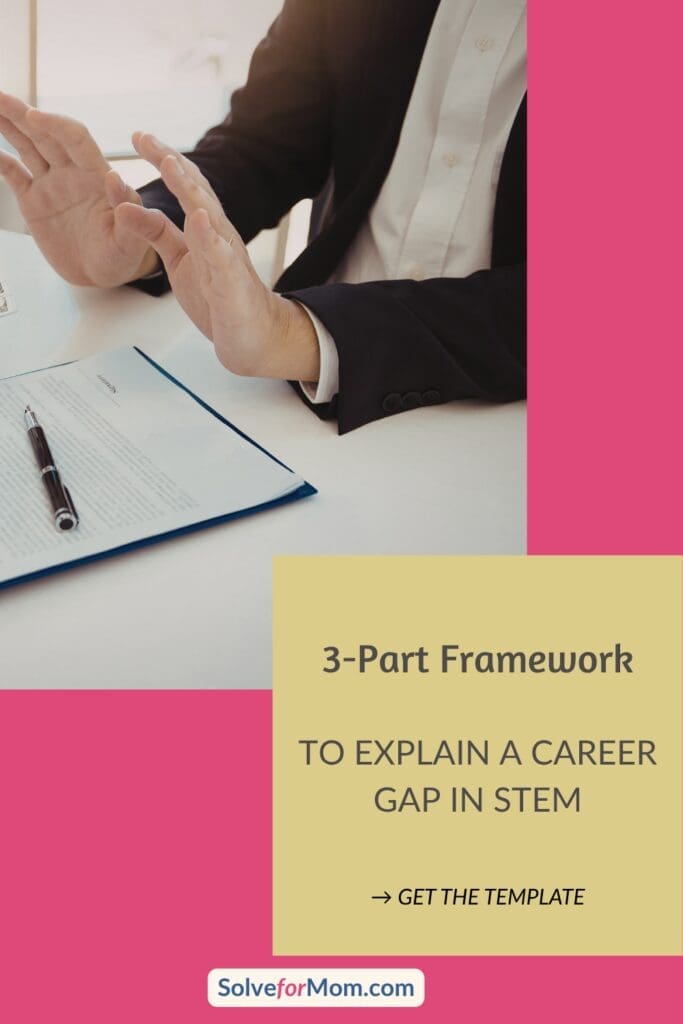
- Use the 3-part structure: neutral facts → credibility bridge → direction forward.
- A short cover letter line can prevent interview anxiety because you’ve already framed it.
- Your “gap → bridge” list is proof that the pause wasn’t empty—it was a season with real skill-building.
- Practice out loud so your nervous system doesn’t treat the interview as the first rehearsal.
- Interviews are two-way: you’re also evaluating whether the culture punishes caregiving.
FAQs About how to address a career break
Use a 3-part structure: neutral facts, a credibility bridge, and direction forward. Keep it under 60 seconds and avoid apologizing or oversharing personal details.
Prepare a 30–60 second script that names the pause neutrally, mentions 1–2 activities that demonstrate competency or bolster your credibility, and ends with why you’re excited about the role now. Then pivot to a strong question like how success is defined in the first 90 days.
In most interviews, it’s completely fine to be ready with a short, structured answer and share it only if you’re asked. That said, if there’s an organic opening (for example, you’re discussing a timeline, a transition, or why you’re excited to return), you can name the pause yourself. Either way, keep it under a minute and end by redirecting the conversation to what you bring to the role.
Not always. Often the best place is a one-sentence cover letter line plus a clear interview script. On your resume, it’s more effective to show relevant activity (courses, certifications, volunteer work) during that time window.
Use one sentence: “After taking a career break to [neutral reason], I’m eager to return to [field]…” Then immediately pivot to why you’re a strong fit for the role.
Keep it neutral and brief: “family caregiving” is enough. You don’t need details. Then bridge to credibility: what you maintained, built, or clarified, and why you’re ready now.
It can be, because STEM hiring often relies on recency and fast pattern-matching. That’s why a structured explanation matters: it prevents others from filling the gap with assumptions.
Practice out loud a few times before the interview—because speaking your answer is different than reading it. Aim for “comfortable and consistent,” not memorized. A simple approach: record a 30–60 second voice note 2–3 times, then tighten any line that makes you stumble.
IF YOU LIKED THIS BLOG
- If you want a bigger return-to-work strategy (beyond the interview script)…→ ⏮️ EP 63: Ready to Return to Work? 3 Career Change Strategies for SAHMs Who Want Flexible, Purpose-Driven Work (Podcast)
- If ‘I’m rusty’ thoughts are showing up…→ 📖 Imposter syndrome in women in STEM: prove-it pressure vs. skills gap? (Blog)
Do you want to turn your messy thoughts into confidence for your next step?
If you want help getting out of your head fast—and turning your messy thoughts into a calm, credible direction—download my free resource: The 2‑Minute Reset for Scientist Moms. It includes simple resets plus the exact AI prompts I use to reframe, like before interviews.
Listen on Science Careers for Moms
Listen to Episode #118 on: APPLE PODCAST | SPOTIFY | YOUTUBE | AMAZON MUSIC
Episode Highlights
- (0:00) Problem: The career gap question is coming—and STEM hiring fills silence with assumptions
- (5:19) Why: Credibility + bias + the motherhood penalty make “gap explanations” feel high-stakes
- (07:02) Solution: 3 strategies to turn a career gap into a “career bridge” (clean, employer-safe structure)
- (19:37) Tactical considerations
- Copy/paste scripts for interview script + cover letter line (without over-explaining)
- Exactly how long your interview answer should be (30–60 seconds)
- How to pivot and move forward in an engaging way
- How to assess culture fit around caregiving expectations
- How to use AI without sounding scripted
- Why practicing out loud matters for your nervous system
- (26:00) Recap
Read the transcript
If you’re in a season of returning to work after a career pause, especially in science and tech, you’re in good company. Because even when you know you’re capable, there’s that nervousness and maybe even judgment that comes at this time. You’re probably asking yourself, is my experience still credible? Should I explain the gap? What if they assume I’m really rusty? What if I sound defensive? Before you update your resume, you hit submit on that application, or schedule an interview, you’re going to want to listen to today’s episode first.
I’m going to show you exactly how to explain your career gap so that you’re in control of the narrative and you approach it with calm, confidence, and zero apologies necessary. There won’t be any awkward moments or lingering doubts, and I’ll even share the sample scripts that you can use for your next job interview. So you’ll definitely want to save the episode and share it with a friend in STEM who is facing her own return to work moment.
All right, let’s do this. Welcome to Science Careers for Moms, the podcast for women in STEM who want to have both a meaningful career and be there for the important things in life. Hi, I’m Anokhi Kapasi, a PhD researcher, business owner, and homeschooling mom of two boys.
I’m passionate about helping moms in science and tech build careers that fit their whole life. Join me for honest conversations with other scientists who’ve gone through the same career decisions you’re facing right now. You’ll also get actionable frameworks that cut through burnout, work-life balance myths, and circular decision making.
If you’re ready to make STEM career decisions that let you be an amazing mom, you’re in the right place. Let’s get into today’s episode. If you’re new here, hi, I’m Anuki Kapasi.
I’m a biomedical researcher and I also am a career strategist for moms in science and tech, but I’m also a mom. So I know what it’s like when you are trying to plan out your career and you’re also trying to lead your kids through a very busy season at home and both of those things overlap. So today’s a very important topic.
Maybe you’re listening right now because you’re looking at your resume and you see this big gaping hole. You’re ready to return to work and you’re preparing for your interview and you can already feel that question that’s just hanging over you. It’s hovering and you’re wondering, how am I going to address this career gap that I have? Your stomach can really drop when you see a big blank space in your resume.
And that’s when that inner dialogue also starts. Well, I’ve been working so hard for this career and I really need to justify my absence. And you have to toe that fine line because you have to provide an explanation, but you don’t want to sound overly defensive either.
So how do you make sure you say enough, but not too much? Yeah, when you’re in this situation, it can be really intense. So much of science and tech is based on how much credibility you’ve built, all of your experience, who you’ve worked with, where you’ve shown up, but then what do you do if your timeline isn’t really clean? You’ve got pauses and breaks. If you don’t offer an explanation, then other people are going to basically fill in the blanks for you.
And I know that’s not fair, especially when you’ve taken a career pause for the most important life reasons and very human reasons. You are a caregiver. Maybe you’re managing a health problem.
You’re recovering from burnout because you’ve worked so hard. Perhaps something was out of your control and you were laid off. Or maybe you just needed to choose a season where your family took priority.
So did you know that about 30 to 50% of working women actually take career breaks? And this usually coincides with becoming a mom. The number is different depending on which survey you look at. And it doesn’t matter what you call it, a career pause, a career break, a career sabbatical.
But the interesting thing is that the majority of those women who go on and take career breaks also then eventually return back to work. And I’m talking about the vast majority. Now, these are general statistics, but I also believe that this represents the STEM-trained mom.
And the reason I point this out is that if this is you, I want you to know that you’re not an outlier. This is a very consistent and real pattern that we’re seeing for modern working women. So that’s why in today’s episode, I’m going to walk you through some ways of talking about your career gap at the moments that are really important when you’re presenting your CV to someone and talking about it in your cover letter is a good strategy.
Or how are you going to talk about that career gap when it comes up during an interview? You don’t want to be caught off guard. So it’s really good to think about this and have stuff prepared. I’m going to show you how to talk about it in a very calm and competent manner.
I’m going to show you simple bridging techniques so that you can pivot and take something that seems like a career weakness and turn it into an actual career strength. You’re going to want to stay to the end because that’s when I’m going to share real tacticals of exactly what to say and when to say it and how to say it. And I just want to start off by asking, do you think that career pauses are actually a problem, right? If so many women are taking them, how is this still a problem? Well, in many ways, a career gap can cost you some opportunities in STEM.
We actually have a name for this. It’s called the motherhood penalty. And if you haven’t heard of that term before, it’s when women choose to take a career pause at the time that they become moms and that there is some sort of penalty that they’re paying for in their careers.
For one, their upward trajectory has stalled. And for two, your salary is probably frozen during this time. And those costs are actually quantifiable and visible.
But there’s also a third one, and that is that you have to get over this credibility hump. When you are trying to return to work, you have to go above and beyond, it seems, to explain away this gap, which doesn’t feel fair, but that is the situation that we live in right now. And the problem is, is that if you don’t deliver that explanation properly, it can cost you opportunities.
If you provide an unstructured and unplanned explanation, or you sound too defensive, or your lack of confidence comes through, that can be a problem. Now, you don’t have to have a perfect explanation, but you do need to reassert your credibility. And especially when you are talking about a job that requires a high level of skill.
So what I want to show you is how you can come from a position of power and outline the intentionality in all of your choices, that these things didn’t just happen by accident. You want to be able to convey how you’ve been very intentional and thoughtful in how you managed your career pause. So I’m going to share three strategies that will help you prepare a great explanation for your career gap.
And then at the end, I’m going to provide very tactical things that you can do. So number one, you want to be clear about why you took that career pause in the first place. What specific season were you going through? And how long was that pause? You want to state these facts without any drama.
So we can actually even do this now. Just grab a pen. You can set a very short five minute timer.
And then I want you to write down what season you’re in, the reason you took the break, how long the break was for, and why you are choosing to return. Just be really honest with yourself. So pause this episode and see if you can do that right now.
So here’s an example. Maybe it was a season when your kid was a newborn and sleep was just really chaotic. You were working at a job where your PI was pushing you to publish a lot.
And there were a lot of paper revisions and you had really short timelines, like 48 hour turnarounds. And you were starting to get burnt out. You realized that you were basically working two full time jobs and you didn’t feel like the quality of your work was really coming through at either end.
So you made a very intentional decision to pause your paid work for a very defined season. You went in knowing that you were going to have a very specific amount of time where you would just focus on family. You would focus on caregiving and you would stabilize that part of your life.
But now you’ve come to the end of that window and you are ready to reenter the workforce and you are trying to develop a clear plan. So why are we doing this? You’re doing this for one, yourself, but you’re also doing it so that you can articulate it to others. Because if you’re not clear and confident about the reason, then that uncertainty is going to come through.
Your brain is trying to protect you from all of this judgment. But sometimes when we’re in that situation, it comes out like defensive storytelling. When you can get really clear about things, it kind of shuts all of that defensiveness out.
There’s no room for it. When you get this level of clarity, it’s also going to make your story very consistent. The reason for your pause can match the length of time that you’ve taken for it and you just sound much more grounded and credible.
Now there are two main places where you’re going to have to provide an explanation. One is being able to position that experience when you share your CV with someone. And the second is during an interview.
When you’re clear on why you paused and what season of life it was, then you can just say it once very neutrally and move on without the whole conversation spiraling or it leading to you oversharing all of this personal information. And don’t forget interviews are a two-way interaction. You are interviewing them as much as they are interviewing you.
So if your reasons don’t seem to jive with them, then that’s a red flag. Maybe this isn’t the right company culture for you. The second thing you want to do is document your proof and credibility.
What did you do during the career pause? What can be seen as a benefit? And what I’m talking about is turning that pause into kind of a power move. What skills were you able to maintain? Did you build any new skills? Are you much clearer about your direction? As I mentioned earlier, hiring in STEM is very much based on your experience and what you can document. So if you’re only describing all of these things that you paused, what you stopped doing, and why you stopped those things, then people are going to start making assumptions about your skills getting cold or that there’s going to be a huge learning curve for you to get back into the swing of things.
But if you can name what you gained during that pause, then it’s not that you had a career gap. You actually had a career bridge. You can fill that gap in with something concrete that a hiring manager can actually evaluate.
This is something you can do now. You can create your gap to bridge list. So get a piece of paper and divide it into three sections.
One section is going to be what you maintained. What skills did you keep warm? The second section are all of the skills that you gained, anything that you built. How did you grow? How did you move yourself forward? What did you learn? Did you get any certifications? Did you keep reviewing papers maybe? Were you in communication with your peers? It can be small things.
It doesn’t have to be huge groundbreaking things. Anything that can be interpreted as you having continued or grown new skills. Did you expand your network? Did you take part in any speaking engagements? This could be personal or professional.
Did you create different work arrangements? Maybe you were informally helping people. Did you start any passion projects or engage in community outreach and service? Perhaps you started writing more. And then the third section is anything that brought clarity in your direction or can justify why you are pursuing this new role now.
And you want to include something about how you’re better for it now that you’ve taken this career pause and why that actually is good for the company as well. You want to shoot for putting in at least three things into each of those categories. And then for each job that you’re interviewing, you can circle the bullets that best match that particular job.
Okay, so you have this list now of all of the activities you took part in and skills that you gained or maintained during this career pause. How can you package this up? Think about field or industry specific terms that you can label each of these points that you put on your list. Here’s some examples.
Maybe you manage the IEP meetings at school for your child. Well, that involves managing stakeholder meetings, scheduling, and logistics. Perhaps you were dealing with a family health situation.
That involves medical management, dealing with hospital systems, dealing with time sensitive requests, or perhaps you really threw yourself into community services. Well, that would involve outreach, communications, presentations, fundraising, and a good demonstration of soft skills. Making this list, it’s actually a really fun exercise.
I think you’re going to find that it also boosts your confidence too. And if you want more ideas about how to identify your transferable skills, I provide a lot of strategies in episode 63, which is about getting yourself ready to return to work. I’m going to link that in the show notes as well.
But I want to point out that motherhood has really equipped you with more than you realize. And sometimes we forget how much we actually do from all the small things to the big stuff, but you are constantly developing and you have been providing impact. So this is the stage at which you should take stock of all of that.
And you’ll realize that a lot of things that you overlooked are actually really valuable to the job that you’re now pursuing. So you don’t have to pretend that nothing happened just because it’s called a career pause doesn’t mean everything did pause. You should be claiming and owning up to any growth that you made during this time.
Number three is that you should have the right mindset coming in. Returning to work means that you have a renewed sense of vigor and clarity. And if you completed number two, which is creating that credibility list, you’re also now fortified with so many more skills that you can share with your interviewer.
You want to come in with the mindset that you’re now ready to move past this pause and you are ready to return to work. Think about what your potential new employer cares about the most and come in from that perspective. I can’t emphasize enough your mindset, framing, and your language matter a lot when you’re trying to talk about your career gap.
You want to get across that this was an intentional pause and that you had a really strong reason. It was in order to, and then go back, see what you said in step one, which is getting clear on your why. And you want to get across that this time was not wasted.
During this time, and then include some of the items from that bridge list. So what I’m trying to say is that you don’t want to come from a place of deficit. And I know it can feel like you’re really disconnected from life and you feel really stuck because your career was such a big part of you.
And then you took this break. So who am I now? Right? You can feel invisible and lonely, and maybe you needed a break and you didn’t actually intend for this to be as long of a career pause as it ended up being. And if you’re being really honest, maybe you even feel a little desperate.
You need things to change. Look, all of that is okay. It’s okay to feel that way.
That’s just being human. But what if we reframe that? What if your career break wasn’t actually a step back, but actually a power move? Don’t discredit what you gained during that break. If you need a reminder, go back to that bridge list.
But sometimes mindset shifts can be so hard to do on your own. If you need a bit of help and you want to know the exact method to go from self-doubt, like from a job interview after a career pause, to sounding calm and credible and clear in under two minutes, you’re going to want to grab my free download called the 2 Minute Reset for Scientist Moms. It’s a quick guide, it’s completely free, and it comes with the exact AI prompts that you can use to help calm your nervous system really fast, stop that apology energy that can come out in us sometimes, and also turn your messy thoughts into really helpful next steps.
So head over to solveformom.com forward slash resources and download it. Now you might be nervous about bypassing any bias that comes with being hired as a mom who’s paused her career and is now trying to re-enter the workforce. But this PDF with simple resets as a mom in STEM is exactly what you need, especially right before you walk into an interview.
Again, you can grab that at solveformom.com forward slash resources. Now by returning to work and showing up and interviewing, what you’re really doing is demonstrating your confidence that you’re ready to reconnect with the people in your field of work, and that you also plan to contribute again in a new setting. Because remember, you never stopped contributing during that pause.
You were doing all kinds of things, but now you’re going to do it in a new setting. So you probably already know that interviews are really about fast pattern matching. And that’s why if you ramble and you look really uncertain, if you overshare or you accidentally hand them things that can trigger some of the biases that probably already exist, then they’re not going to correctly identify you as a good match for their company.
And don’t forget, as I mentioned earlier, that the interview is two way. You’re not just trying to pass their test, but you’re also evaluating whether this is the right culture for you. Is it a culture that punishes you for the fact that you’re a caregiver? Or does it respect you as a whole human being? Because if that’s not obvious during the interview, then imagine what it’s going to be like when you’re actually working and you do have to leave strictly at 2.45 in order to pick your kids up at school at 3. Imagine what happens when you need your weekends for your family, right? You can’t start a job constantly apologizing for having a life or being a mom.
So make sure you are also ready to assess this company that you’re now trying to get a job with. Okay, now for the fun part. You want to have two scripts.
One sentence that you can include as part of your CV. And then the second is a 30 to 60 second explanation that you can provide during an interview. Okay, so I’m going to tell you exactly how to do these.
For your CV, usually the cover letter is the ideal place for you to reframe your career break as something that’s positive. The rule of thumb is to mention it in the cover letter if your posit was more than one year. Because this is really a great way for you to take control.
You’re getting ahead of the game, and you’re introducing this idea like, yes, this career positive happened, and this is why. But if you paused your career for less than that, then don’t feel like you actually have to mention it up front like that. You could just leave it for the interview, it probably will come up then.
An example of what you could say in your cover letter is, after taking a career break to take care of a family member, I’m eager to re-enter the workforce and particularly interested in this role because, and then say your reasons. You don’t actually need to mention it in the resume itself specifically if you’ve already mentioned it in the cover letter. And even if you haven’t mentioned in the cover letter, it may not actually be something that’s worth mentioning or pointing out in your resume.
But it does help to see that there are skills and activities that were happening during the same window of time that your gap in your job happened. With the resume, it can be very scannable. So if there’s an opportunity, you want to put in any volunteer work, community work, courses you took.
Did you attend any professional society or events? Did you gain a certification? Those things with exactly when you took part in those would be really helpful because then when somebody’s looking at it, it’s like, oh, you didn’t just completely fall off the face of the earth. You were doing things. You just had a different priority at that time.
I will add a little caveat. In some very rare cases, it could make sense for you to actually point out that you had a break there. I wouldn’t call it that, but if you did something that was super significant, it just like maybe you wrote a book or something that is worth mentioning, but it happened to be when you were unemployed, then you can put it down as something like independent consulting or professional development or professional writing.
And what I mean by that is in the section for your experience where you have a list of all the different positions you’ve held, right? With the range of years that you held those positions. If you were engaged in a very significant notable activity, you could put that down as a position. Okay.
But for most of us where we’ve had a career pause for more than a year, it probably just bears mentioning with one sentence in a cover letter and nowhere else. The other place that you need to talk about it or be prepared to talk about it is during the interview. When it comes time to you explaining it in the interview, you don’t want to overexplain.
I would just recommend that you see what feels most natural. This is what I’ve done. I’m prepared to answer something if I’m asked about my career pause, but I usually don’t just bring it up.
However, sometimes there is a very organic conversation and sort of a key opening for you to very naturally point it out in that conversation. And if you capture that moment, it could be an opportunity for you to bring it up yourself and keep it very positive. So I would say it really is just based on your comfort level and your feeling.
If you’d rather them bring it up and you answer it if it comes up and not otherwise, that’s fine. But if you feel like, Hey, this conversation is going well, and it just makes sense. I want to get on top of it.
And I want to mention something really briefly about it. You can do that too. So I’ll give you an example of what you could say.
And it’s about three or four sentences. It doesn’t have to be any longer than that. It’ll take less than a minute to say.
So you can first mention that you took the break. After taking a planned career break for family caregiving, I’m really excited to return to biomedical research. Then you want to say something about what you did during that time.
During this time, I was able to maintain and then list whatever you did. Got a certification, maybe had some publications, did some part-time work. But even if it’s not that, if it’s some other sort of transferable skills, you can lightly mention those.
And then you want to talk about the current role. This role is a perfect fit because, and then add your reasons for this job. And then the critical part is now that that’s out of the way, you’re in control and you can pivot the conversation and it’ll show that you’re really engaged and thoughtful.
So you can say something like, and I’d really love to hear how your team defined success, especially for someone who’s ramping back in, say the first 90 days or so. Now a pro tip is to leverage AI. This is a perfect use for it.
You want to include in your prompt, all of the things you did. So you can take your reasons from the clarification step. You can take all of your bridge skills from the second step, and then you can add any other details that you want and make sure that the AI knows what role you were interviewing for.
What you can ask it to do is to build your resume in a way that ensures your career pause is positioned for strength and not as an area of deficit. It’s also going to be able to use all of the right terms for your field. And you can also ask AI to draft example lines for your cover letter.
Now, when it comes to the interview script, I really think that it’s better for you to just ask it for talking points because you don’t want to be spouting out an AI generated script. You want it to sound like you. So it can give you some ideas to make sure you cover all of the bases we talked about in this episode, but then it should be your words and it should be described the way you would say it.
The important part is, is that whatever you prepare to say, you want to be able to practice out loud because that is training your nervous system. You don’t want the first time you have to explain it to be at the interview. You have to have some kind of idea of what you’re going to say, even if the words that you say each time are not exactly the same.
It doesn’t have to be memorized. It just has to be comfortable when you say it. I want to thank you guys for spending your time with me today, especially if you’re in a season where you’re juggling returning back to your STEM job and then everything like life and home and all of that.
I get it. So I really appreciate your time today. The three parts that we talked about is one, be clear about why you took the career pause.
Two, document your proof and credibility. And three, have the right mindset coming in to any conversation about your career pause. You also want to consider the places that you might need to address a career gap.
That could be during the interview. It could be on your cover letter and possibly including it as a role in your resume or on LinkedIn. The two things that you want conveyed when you talk about your career pause is one, that it was an intentional pause.
You had a very strong reason. And two, that that time was not wasted. And if you want feedback on your exact wording, your resume version, your cover letter lines, or your interview answer, you can just send me a question on my contacts page.
Or if you want to have a live conversation, you can actually book a quick free call with me and you’ll be able to find all those links that I mentioned in the show notes. You are a strong woman and I thank you so much for all that you do. I’ll see you on the next episode of Science Careers for Moms with Anokhi Karasi.
I hope today’s episode will help you make your next right move as a scientist and a mom. And if you enjoyed it, would you share it with a friend or post it on your social media? Your voice truly helps other women in STEM find these conversations when they feel stuck. I also want to make this show an even greater experience for you.
So it would be amazing to hear what you think when you leave a review on Apple Podcasts. And don’t forget to add this show to your playlist right now. Thank you for making my show a part of your day and I’ll see you soon for another episode of Science Careers for Moms.
