

Lily Asongfac on Building a Space Career from Cameroon | Science Careers for Moms
August 28, 2026
Overview
Lily Asongfac grew up in Cameroon with no space program, no library internet, and no one to answer her questions about the moon.
Today she’s an international account manager at a space startup and the founder of a project bringing space education to kids across Africa.
She built a career in an industry that didn’t technically exist where she started. Here’s how.
Key Takeaways:
- Space isn’t just for rocket scientists. Lawyers, accountants, doctors, communicators, and other professionals can all find a role in the space industry.
- Your existing skills already point somewhere. Agriculture, medicine, software and AI all map to a specialized space career, if you know where to look.
- Soft skills count more than you think. The problem-solving you do every day as a mom translates directly into this kind of pivot.
- Track your milestones (publicly and privately). It keeps you going. It also helps opportunity find you.
- Rejection means redirection, not failure. Lily applies to grants, scholarships, events, and opportunities even if she doesn’t feel ready.
- Plus: the professional barriers Lily faced, including geography and gender, and how she moved through them anyway.
Meet Lily Asongfac: A Cameroonian Space Educator Who Started With Nothing
Lily didn’t have a space program. She didn’t have a mentor. She didn’t even have reliable internet.
What she had was one question that wouldn’t leave her alone: how does a person actually get to the moon?
Today, she’s opening that same door for other women in STEM who assume it’s already closed to them. This episode is about what she did with that question and what it actually looks like to build access to a career that doesn’t exist yet where you’re standing.
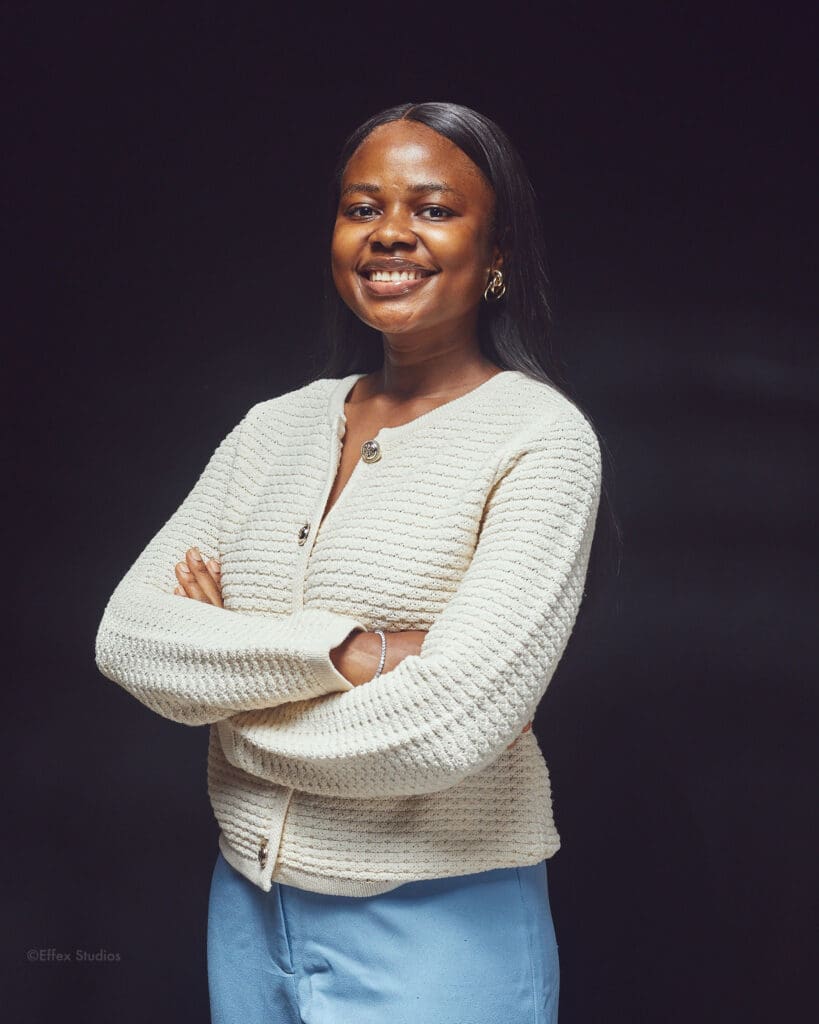
“My reason for existing in the industry is pretty much to get more people, especially the non-technical population to know about the opportunities that exist in the space industry, and also why space is important.”
From a Classroom in Cameroon to an International Space Career
It started with a teacher mentioning Neil Armstrong in a classroom with no way to answer the follow-up questions.
Years later, with a laptop and a library, Lily typed “how did you get to the moon” into Google. And she couldn’t stop reading.
From there: a telecommunications degree. Then a simple cold-call style LinkedIn message to a professor led to a long-term mentorship and a thesis project on satellites. That’s how she walked into a career in an industry her own country doesn’t officially have.
That same refusal to stop at “I don’t know”, is what led her to start the Aerospace Baby Project. There, she brings space education to kids who are asking the exact questions she once did.
The exact three moves Lily used, and how to apply them to your own career, are broken down in the episode: Women in STEM With No Access? How Lily Asongac Built an Aerospace Career Anyway
What This Means If You Feel Boxed Out of a STEM Career
You don’t need a massive pivot.
Maybe it’s one email, one course, one milestone you finally write down. Here’s Lily’s rule for reaching out to strangers online: “What’s the worst that could happen? They’ll say no, or they won’t reply. I’ll try anyway.”
Her work extends beyond her career. Two of her mentees are now studying abroad on full scholarships, in space cybersecurity and space science.
If your STEM career feels stalled because you’re waiting for an open door, then listen to this episode. It’s your evidence that it can still be built.
Questions Answered in This Episode
- How do you approach career planning in STEM when there’s no obvious path?
- How do you build a STEM career with no connections or country-level support?
- How do you find a mentor when you’re starting at zero?
- Which skills actually transfer when you want to pivot into a new STEM field?
🎧 Know a woman in STEM who feels boxed out of the career she actually wants? → Send her this one.
About Lily Rospeen Asongfac
Lily Rospeen Asongfac is a Cameroonian space educator and International Account Manager at SpaceVrse. From a country with no space infrastructure, she built a space career. Lily founded the Aerospace Baby Project to open STEM paths through mentorship. She is a TEDx speaker, a TechWomen Fellow with the U.S. Department of State. Lily Asongfac was named one of the “Women Engineers You Should Know” by the Society of Women Engineers (2024).
- LinkedIn: linkedin.com/in/lilyasongfac
- Instagram: @lilyrospeen
- X: @LilyAsongfac
You can have the STEM Career of your Dreams
One micro-step at a time, use the tools and frameworks that help you design the STEM career you actually want. Join The Better Baseline, my free newsletter for women in STEM building careers that fit motherhood
Listen on Science Careers for Moms
Listen to Episode on: APPLE PODCAST | SPOTIFY | YOUTUBE | AMAZON MUSIC
Episode Highlights
- (5:42): Space careers are an ecosystem of diverse roles and skills
- (9:11): The new space economy is lowering the barrier to entry
- (15:35): Lily’s origin story, from a curious kid with no resources to an international space professional
- (18:35): How to find a mentor, the LinkedIn strategy that launched her career
- (27:40): How existing skills support a STEM career pivot
- (29:53): Soft skills moms already have that translate into STEM careers
- (39:50): Rejection as redirection
- (41:58): Tracking milestones, the spreadsheet habit that keeps you moving
- (44:27): Career planning when you feel like you have no access
Click to read transcript
Hello and welcome back. Well, today I have a guest for you who is living proof that not having access to information, support, or infrastructure for your career path doesn’t have to be a dead end to your career aspirations. And I wanted you to hear her story because you’re probably wondering, is it even possible to build the career that I want from where I’m starting right now? Well, today’s guest, Lili Raspin, a Songfax starting point, might be different from yours as a mom navigating a STEM career. But her guiding principles will still be valuable to you.
Lili is a Cameroonian space educator where she’s helping more people see how space connects to everyday life and how many different careers can actually fit inside the space ecosystem. And in our conversation, we talk about building a space career in a country where this field of work is practically non-existent and the practical steps that she took in order to open doors for herself. Now, what makes Lili uniquely valuable to you as an ambitious woman in STEM is that she doesn’t just inspire you.
She gives you a repeatable plan that you can use to gain access and visibility for moments when you feel boxed out and you don’t feel like you have the extra time or extra money or extra space to really move forward. In this conversation, we cover how Lili became a space professional from a country without space capabilities, breaking barriers and building from zero. Why space is an ecosystem.
It’s not just a collection of rocket scientists and how that unlocks more career opportunities for women in STEM and may even be a career path that you had never considered before. How you can build more opportunity for yourself through mentorship and outreach and building a community that’s going to support you. And why tracking and sharing your milestones can actually create more career momentum for you.
I hope this episode is going to meet you right where you’re at. You might even have your daughters or students listen in. A word of caution: this episode will reinvigorate those childhood dreams and passions about what you would be when you grew up. Welcome to Science Careers for Moms, the podcast for women in STEM who want to have both a meaningful career and be there for the important things in life. Hi, I’m Anuki Kapasi, a PhD researcher, business owner, and homeschooling mom of two boys.
I’m passionate about helping moms in science and tech build careers that fit their whole life. Join me for honest conversations with other scientists who’ve gone through the same career decisions you’re facing right now. You’ll also get actionable frameworks that cut through burnout, work-life balance myths, and circular decision making.
If you’re ready to make STEM career decisions that let you be an amazing mom, you’re in the right place. Let’s get into today’s episode. If you’ve ever felt like you’re starting from zero for building the career that you actually want, then stick around because Lily’s story is going to challenge all of that.
And when you’re ready to build a science career that fits your real life, then make sure to sign up for The Better Baseline, my newsletter. It’s free and the link is in the show notes. I am really excited about today’s conversation because I feel lucky to be able to introduce my special guest today, Lily Rosbein-Ossongfak, a Cameroonian space educator and a leader in international partnerships.
She’s helping to expand what’s possible in space and STEM by turning, quote unquote, no access into real pathways. She does that through community building, collaboration, and hands-on education. Lily is an international account manager at Spaceverse where she builds partnerships across the globe. And she’s also the founder of the Aerospace Baby Project. She brings space education to children through engaging story-driven learning experiences.
She’s a national point of contact for SGAC Cameroon. She’s also the founder of Youths for Sustainable Space Development, Y4SSD. It creates opportunities for young people to step into the future of space science, especially across emerging space ecosystems. Her work has been recognized internationally. Her honors include the African Space Leader Award and the Nebula Award.
She’s also obtained recognition as a Tech Woman Fellow by the U.S. Department of State. At the heart of Lily’s message is this, success isn’t about where you start, it’s about the communities you empower and the futures you unlock.
So Lily, welcome to Science Careers for Moms. I am so glad to have you here. Thank you so much for having me.
It’s my pleasure. Well, I mean, just wow. I was reading that and I read it a couple times as well before and impressed every time that I go through your whole work history here.
And, you know, I think I even left out, but did you, you took the stage at a TEDx event, right? Yes, exactly one year ago. Yes. Wow.
Wow. I mean, that’s also amazing. So I’m going to have to ask you about that experience as well.
But, you know, let’s just start here. For the listeners who are meeting you for the first time, what do you do exactly in the space industry? You can start with what you do now, or you can give a little more context to that bio I read. And specifically, help us understand what problem you’re really committed to solving right now.
So thank you for the question. To answer the very first one, what I really do in the space industry, I do wear a few hats, which I will briefly go through. But at the very core of it all, my reason for existing in the industry is pretty much to get more people, especially the non-technical population to know about the opportunities that exist in the space industry, and also why space is important.
I am the international account manager for Spaceverse, which is a space startup. And what we’re trying to do at Spaceverse is to teach the public about what goes on within the space industry. And we’re getting the experts themselves to share their stories, how they got into space, what they love so much about space, and also how anyone else can get into space.
My experience over the past five plus years in the space industry is that space is diverse. You know, most times when we talk space, people think astronauts only, and maybe Neil Armstrong, and recently the Artemis mission, which we are all so excited about. And we had the first ever woman to, you know, go to the moon or orbit the moon.
And it’s been a very difficult, I would say, journey. Because most times when I try to tell people about the space industry, they’re like, oh, especially from a country like mine, Cameroon, and maybe most of the African continent as a whole, other countries on the continent. Most times when we tell people about space, they’re not already working in space or STEM-inclined. The first question is, what’s my business with space?
Like, what do I as a normal person, or maybe a local farmer or a banker, how does space affect my life? You know, we’re talking space, or you’re telling me about space, but we have some challenges back here.
Maybe there’s no electricity, we’ve got bad roads, no access to clean water in some areas, but you’re talking space, that sounds like a Western problem. But you know, at the very core, it starts the moment we wake up in the morning. Some people are checking weather forecasts.
Others are trying to get somewhere using Google Maps or another navigation app. All of that is using space. That includes checking the weather, calling your child abroad, or finding the fastest route and checking traffic.
My work ranges from my international accounts manager role to teaching children in primary school classrooms through the Aerospace Baby Project. I’m trying to tell people of all ages that space is important. That includes partners in my corporate job and children in classrooms. Space is here to make life better for all of us. And space has already been doing that, whether we know it or not.
So it’s a very diverse industry, you do not necessarily need to have a STEM background to work in space.
There are space lawyers, this is something I only got to know, actually working in the industry myself, seeing how diverse it is, and anybody literally can have a space in space. So the space lawyers, for example, like I was mentioning, people with an accounting background, auditors and all of that, have roles that they play in the space industry. There is a new space economy, which is becoming a very interesting pivot for the industry as a whole. It’s helping countries that normally would not have access to space gain access.
Because now things are, through nanosatellites, for example, you can get a satellite in space, you don’t have to spend so much money as they would in the past with traditional satellites. So that’s just a resume of the different things that I do, but it all comes to one big message, access to space for all. I just love everything you said there.
I too, even though I have a STEM background, I thought being in the space side of things that it was exclusively science, and that you literally had to be a rocket scientist to work in this whole field of work. Obviously, there is that segment of people that work in this field, but then there’s this whole other ecosystem.
And I was wondering why you use that word ecosystem to describe it, but now I understand what you’re talking about, that all the different talent and roles that support and sustain, not just the technical part, but literally to have it not run as a business, but as this big international project, right? Right now, just from your specific country, are you also sharing resources such as talent? Or is your goal to now find more talent? And I’m not just talking about space scientists, but all the supporting roles that you just talked about.
Is it your goal to try to shore up those skills within your country? So I would say yes, but not in its entirety, because most times when we talk about space and then people in turn hear about it and go, oh, I’m a lawyer. I have a degree in law. I’ve been doing business law.
It means I could possibly get an opportunity in space. Or you could have someone who loved the idea of moonwalks as a kid. They may have imagined doing all this amazing stuff in space or drawn it when they were younger. But because of where they found themselves, that curiosity had shut down.
And maybe they’re working as an accountant in some accounting firm, and they hear about space again, and they’re like, oh, it means I can actually divert and get into this industry because I already love it. So we’re not trying to get, we’re not trying to sell space as it’s fancy, come work here. But the tagline would be something like, if you had a passion for space, if you had questions about space when you’re younger, and because of where you found yourself, you did not end up pursuing that, now you can get back, regardless of what you’re doing.
You could be a medical doctor and move into space medicine. There’s so much going on. People are doing stem cell research on the ISS. That’s the International Space Station. We’re looking for the next cure of cancer.
We’re trying to see if space, and the space station as a laboratory could help us understand things about the human body more. So that’s like space medicine, very cool stuff. This astrobiology, maybe there’s some lady somewhere, or some guy somewhere who is now working in an agricultural firm, they’re doing veterinary medicine or agricultural, and now we’re telling them about astrobiology, which is a field in space where people who are passionate about agriculture and sustaining and nutrition for years to come, including if we’re eventually talking about colonizing other planets like Mars, I’m sure you’ve heard about that.
But if we’re talking about going to the moon and Mars, then we have to have in mind what these astronauts would be feeding on. So that’s where astrobiology comes in, they’re doing all that research, making sure, seeing what can grow where and what cannot grow where, and things around that. Yeah, okay, that makes a lot more sense.
Thank you for clarifying that.
I was actually going to ask how you enter and work within the space industry. I guess I’ll call it that for now. I wasn’t sure if you kind of have to start by centering yourself on space work and then seeing what is needed and then build the skills for that.
But it sounds like you’re talking about existing talent and people who once had a passion for space. They can reinvigorate that passion by redirecting their work toward fueling space work. So that’s really cool, just talking about it as a possible career shift, which is a big part of what I talk about on the show. And so I love that you’re opening up people’s minds to the possibility that whatever skills they have right now could potentially help in further, you know, this really important work in a space field.
And also that opening up our minds to the fact that it is so multidisciplinary, that there are all these different roles, like you said, these diverse roles that build the ecosystem. But also as a single person, you have a multidisciplinary role that you could be trained in one expertise, have passions in other areas, and bring them together and offer that multidisciplinary approach to, you know, furthering space work. So, you know, you certainly have been opening up my mind already.
I’m very curious, because you talk about becoming a space professional and, for example, potentially shifting your current work to applying it to the space field. You come from a country that doesn’t have its own dedicated space capabilities. So for you, what was your journey? And what were the major turning points that made your current career possible? I love that question, because every time I have to talk about my journey, it gets me really excited.
So I’ll start with how I got to know about space, you know, to begin with. When I was in primary school, that would be elementary school in the US. In other parts of the world, it’s primary school. One day, my class teacher came to class and told us about Armstrong being the very first man to walk on the moon.
And I was amazed. I’m like, what? What do you mean a man has been to the moon? How did that happen?
You know, is the moon a location? Is it a destination?
Do you get on a plane to go to the moon? I was young. I was curious.
I asked questions. But being where I was, there were no libraries, no access to mobile phones with internet like we have today. So a lot of people didn’t know.
And they just gave me answers to shut me up. Like, okay, probably he just got there. However, who cares? But I was I wasn’t satisfied with that.
I needed to know how, you know, people get to the moon. I was good in math, mathematics. Later on, I went to high school, did science, majored in science.
During my first year at university, I had a laptop and a mobile phone. I also had access to the internet. And I was in the uni that had a library. And all of that access one day when I was doing homework from school from a lecture, I remembered that I had questions about space.
And now I have tools that could possibly give me answers. So I used Google, Google is your friend. And I literally typed in the words, how did you get to the moon? And that was it.
That’s how I got. I got to learn about space. I started reading, reading about rockets, reading about the whole career of an astronaut.
You know, there are people called astronauts. And this is how they leave on the ISS. Sometimes they’re going to, you know, the moon, other times they’re going to the laboratory and, and stuff like that.
So I, I was already studying for a degree in telecommunications engineering. And what I decided to do was I was going to check how space blends with telecoms engineering. Then I learned about satellites.
And then I was like, okay, satellites, I think this is what I want to do. I want to work on satellites, I want to build satellites. Fast forward, I took online courses reached out to people on social media, LinkedIn, mostly people who were already working in space.
And it was a brief introduction. Hi, I’m Lily from Cameroon. I love space.
I’m curious. I’d love to know how the industry works. Would you mentor me?
Sometimes I was like, would you teach me? Would you mentor me? I remember reaching out to one doctor. He was a professor at a university in South Africa.
And I told him about myself, good thing he was he was also Cameroonian. But he was working as a professor in South Africa, in a department where they worked with with space and satellites. So when I told him about myself, my passion, he was like, you know what, I’m going to help you, you know, let’s do this, link me up with someone from your department, our course of you on the space project.
And that’s, that’s what my final year thesis was, I worked on a project with a South African satellite for the Gabonese Space Agency. Cameroon doesn’t have anything going on as far as the space industry is concerned, like you highlighted, but there are a few, literally about five people in space. And I am lucky to be among them now.
But at that time, there were very few, so I could reach out to each and every one of them. And I told him about myself. And I’m really glad because they were very helpful.
So I’m going to say people, a community, reaching out, not being afraid, you know, asking people to mentor you or to teach you something is is the way I went about it. I wasn’t scared. I thought, what’s the worst that could happen? They’ll say no or not reply.
I’ll try anyway. So yes, that’s that’s how I got into the space industry from a country without space capabilities. Before we keep going, I want to pause on something Lily is showing us so clearly.
Access is not always handed to you. Sometimes you have to build it one small move at a time. You learn, reach out, track your wins, and refuse to disqualify yourself before you even try. That is exactly the kind of micro change that we talk about inside the Better Base Line, my weekly newsletter for moms in STEM who want a career that fits motherhood without burning everything down to get there.
So make sure to click on the link in the show notes. I love that story because it reminds me a lot of my story now. I had a couple of career shifts, I would say, but mine were not very drastic.
I am a biomedical researcher trained in the laboratory. Towards the end of my PhD, I realized that I didn’t want to go into academia. I didn’t want to follow the professor track of getting tenure and working with a university and conducting research that way.
But I also got interested in epidemiology and I thought, oh, how cool. Instead of me looking at subcellular, I could look at population level. And I thought, there is no way I’m going to go back to school and get a whole other degree and all this stuff.
But the skill set was different, right? Doing laboratory work versus statistical analyses. And so I thought, how am I going to be able to make the shift? And I literally did exactly what you did, not different country. I’m sharing this story to reiterate the power of reaching out and finding mentors. People can make a huge difference in your career. When you’re honest with them, they really do want to help you.
And so I did the same thing. I went out to this department in the university that was under construction at the time. And so all the professors and researchers were in a trailer park, basically.
I knocked on the doors one by one and made an offer. I said, hey, I’ll help with your research in my free time if you can mentor and train me. And eventually, I found a professor who was really excited to work with me as well because he was looking for somebody who had a molecular biology background. So it turned out to be very mutually beneficial.
But it just, your story reminds me of what I did and how I actually entered a whole different line of work than I thought I was going to do when I was going through grad school. So I totally believe you when you say that finding a mentor or somebody who’s willing to teach you and leaning into people virtually or in front of you. Yeah, so thank you for sharing that.
I want to switch gears because you’ve given us a good idea of who might be involved in space work. You’ve also explained what it took for you to get there. That includes the technical side, networking, curiosity, and pulling on that thread until it led somewhere big. And what is it that you do sort of on a day-to-day or week-to-week basis?
Can you kind of summarize what your major responsibilities are so people understand a little more specifically in your role, I know is more technical maybe, but you also have those broader interests in terms of education and things. So all of these roles that you take on, can you explain to us what you do? Yes, sure.
In my current role at Spaceverse, I manage relationships. That starts with scouting, in quotes, partners. I reach out, tell them about the project we’re working on, and invite them to come on board.
The entire process includes signing an MOU and getting on meetings to close that deal. That’s pretty much what I do every day.
So I’m sending tons of emails and going back and forth with our partners and industry experts. They join our Spaceverse Friends for Space series. As I mentioned earlier, we invite space industry experts to share their work through a video interview.
There are several ways we get them to contribute, share, and inspire the public about space. So yeah, that’s what my role looks like in a nutshell. I manage partnerships, I create and manage partnerships for the company and also doing communications with internet team members.
We have a group of editors, we have a social media team that manages publications for the interviews that we’re doing with the experts. And yes, so that’s it on the Spaceverse side. As a space educator with the Aerospace Baby project, I don’t do this every day, but it happens like once in two months.
I go to schools, I go to a primary school next to me. If they have an event coming up, I’ll reach out to them. Maybe it’s International Day of the Girl Child, International Science Day, or another important day.
I’ll ask for an hour or two to talk to the kids about space and STEM. I encourage them to love mathematics and tell them math is not difficult. So yeah, that’s what the space educator hat that I wear does.
That is so important though, because it makes it so much more real. I feel like space in general, we’re so far removed. You’re describing how the everyday things we use come from what we learn about or set up in space.
So it makes it real for them. A lot of what I knew came through movies or maybe textbooks. It wasn’t right in front of me. I couldn’t see someone who trained, works, and contributes to the field.
I couldn’t ask questions and think, hey, if she did it, I can do it too. That inspiration becomes so much more effective, I think, and really, really important for people who don’t really have a good picture of what this is.
It feels like this like magical thing that happens, especially with Hollywood movies and stuff. Yes, Hollywood doing the absolute best. But that’s exactly why I started doing this.
Because if you remember, my journey started when I was in school, right? And when I had those questions about Neil Armstrong, there was nobody to answer those questions. There was no one to teach me what space really is. And I feel like maybe things would have happened faster, sooner for me.
And so what I’m trying to do is to give back in a way that if there’s a kid somewhere, because they’ve had interaction with me, they would want to pursue their space dreams. And I’m very proud because two of my mentees are actually now studying abroad. Well, one graduated last month.
They got scholarships to travel abroad and study for a master’s in one in space cybersecurity and another in space science. So it’s very rewarding. So I actually tell people that’s my hobby.
That’s what I do in my free time. I go to talk about space because it gives me so much joy. You should be really proud of that.
So congratulations, because you’ve just changed the lives of these people, you know, these students. But that’s exactly why I think that many of us start businesses. It’s often to fill this problem that we encountered and there wasn’t a satisfactory solution to it.
So then we go on and build businesses where we can say, hey, we don’t want people to struggle the way we did. Here’s maybe the shortcut or here’s a solution if you come across this problem. So honestly, in that sense, you are an entrepreneur.
Maybe you’re doing it for a profit mission. You’re more purpose driven rather than trying to maybe make money off of the space education part of things. But the fact is that you’re still an entrepreneur.
You set up a business or set up a company to be able to have a structure in meeting and mentoring kids. And that is a direct result of you not having that when you were younger. So I’m not surprised.
You seem like a very industrious person. So, of course, you have this and your hobby is very much I wouldn’t even refer to it as a hobby because it’s just like I said, you’re doing something that’s very life changing for people. So you have the technical background, but you mentioned other skills.
And I think that many of us in STEM encounter. [Episode Transcript is incomplete]
