

Break Into a New Industry Without a Network or Starting Over
September 23, 2026
Women in STEM can break into a new industry without established connections by translating their existing expertise, learning the industry’s language, reaching out to a few relevant people, and creating visible proof. Begin with the knowledge and resources you already have access to, and start building before you feel ready.
In this article
- How Lily Asongfac connected her telecommunications background to a career in the space industry
- Five practical steps to translate your STEM experience, build relationships, and establish credibility in a new field
- A one-one-one access plan that fits the limited time and changing capacity of moms in STEM

How to break into a new industry with no connections
Breaking into a new industry can feel impossible when everyone else seems to have mentors, referrals, or years of insider experience. For a woman in STEM, that comparison can be especially discouraging when you have deep technical experience but no obvious bridge into the field you want next.
You can build access by translating what you already know, learning the industry’s language, reaching out to a few relevant people, and creating visible proof of your direction and ability.
If you’re a scientist, engineer, or other STEM professional balancing career growth with motherhood, the goal is not to constantly be networking. You can still create access to a new industry with a few intentional steps that don’t consume the time and energy your current work and family already require.
Lily Rospeen Asongfac built a career in the space industry from Cameroon, a country without an established space industry of its own. Her path shows what can happen when curiosity becomes focused learning, learning becomes outreach, and outreach becomes visible work.
You can hear Lily’s full story and find her resources in the episode Show Notes. Here, we’ll focus on what her experience can teach you about entering a new STEM industry without established connections.
Why breaking into a new industry feels impossible without connections
When you look at people who are already established in an industry, you see the network they have now. You don’t see the early questions, unanswered messages, small projects, or awkward first attempts that helped them build it.
That makes it easy to believe the network came first.
Lily’s story suggests a different order. Her interest in space began with a question in primary school after learning that Neil Armstrong had walked on the moon. She did not have the resources to pursue every question then, and she could not point to a clear local path into the space industry.
Later, the absence of an established space industry in Cameroon and the citizenship restrictions connected to parts of the industry created real barriers. Lily didn’t pretend those barriers were insignificant. She started looking for the parts of the path she could influence.
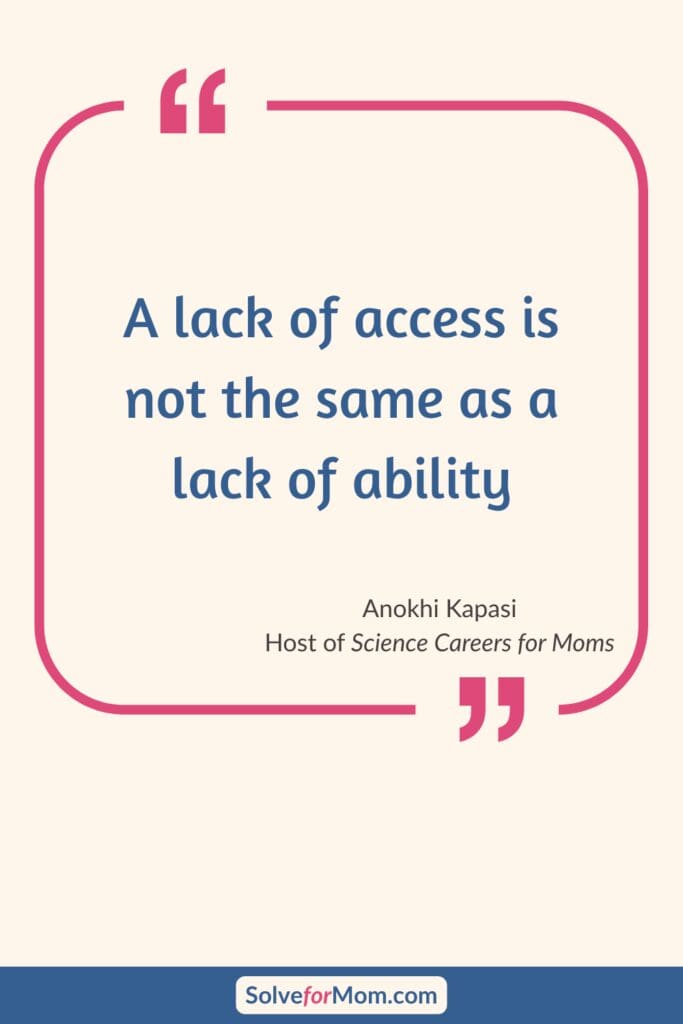
That distinction matters. Your first job is to make the path more visible, then begin building evidence that you can contribute to it.
Step 1. Use transferrable skills to switch industries without starting over
Lily studied telecommunications engineering. Instead of treating space as a completely separate world, she began exploring where telecommunications and space intersected.
That is an important first move for an experienced woman in STEM. Your scientific training, technical judgment, project experience, and ability to solve complex problems don’t disappear because you’re entering a different industry. Before assuming you need to start over, identify what already transfers.
For a mom in STEM, this step can prevent an unnecessary return to school or a transition plan that ignores the expertise you have already built. This discussion about imposter syndrome in women in STEM will help you separate a skills gap from prove-it pressure.
Create a simple three-column map:
| What I already know | Where the new industry uses it | What I need to learn next |
|---|---|---|
| Technical knowledge | Relevant roles, systems, or problems | One specific knowledge gap |
| Project experience | Similar workflows or deliverables | New terminology or context |
| Communication and leadership | Cross-functional or client-facing work | Industry-specific examples |
Look at job descriptions, professional profiles, conference topics, and industry organizations. Notice where your existing experience appears under different language.
You may still need training for a specific role. Some scientific, engineering, clinical, and regulated positions require particular credentials. The point is not to dismiss education. It’s to identify the actual gap before investing time and money in another degree.
And if a career gap or nonlinear path makes you question how employers will interpret your experience, listen to How to Explain a Career Gap in STEM Without Sounding Defensive for a practical way to frame your story.
Step 2. Learn the new industry with the resources you already have
At university, Lily used Google and library access to investigate the question she had carried since childhood: how did people actually get to the moon? As she learned more, she connected that curiosity to her engineering background.
She didn’t begin with a perfect curriculum. She began with a focused question.
That matters for busy moms in STEM because open-ended research can expand until it becomes another unpaid job. A narrow learning question gives you a useful boundary and helps you make progress in shorter blocks of time.
Try the same approach. Choose one question to explore for seven days:
Your seven-day industry-learning sprint
☐ Which roles in this industry use my current skills?
☐ What problems are these teams trying to solve?
☐ Which terms appear repeatedly in job descriptions and professional conversations?
☐ Which qualification is truly required, and which skill can be demonstrated through experience?
☐ Who is already doing the kind of work I want to understand?
A focused question gives your research a stopping point. It also helps you approach professionals with something more useful than, “Can you tell me everything about your career?”
Step 3. Make connections in a new industry before you feel fully qualified
As Lily learned more, she started contacting people in the space industry on LinkedIn. One of those relationships connected her with a Cameroonian professor working in South Africa, who later co-supervised her final-year thesis involving a satellite project for the Gabonese Space Agency.
Her approach to possible rejection was practical:
“What’s the worst that could happen? They’ll say no or not reply.”
You may bring substantial STEM experience to a transition and still feel you need more preparation before approaching someone in the new field. Lily’s story offers a different decision rule: learn enough to ask a thoughtful question, then let the conversation show you what to learn next.
That doesn’t mean blasting dozens of generic messages. You can simply send one focused request that another person can reasonably answer.
A low-pressure first outreach message
Hi [Name], I’m a [current role or background] exploring [specific field]. Your work on [specific topic] caught my attention. Could I ask you one question about [specific issue]? I’d appreciate a short reply or a call if that is easier.
The goal isn’t to ask a stranger to build your career for you. You simply need to learn enough to take the next informed step. If you are trying to understand how to make connections in a new industry and how to network in STEM as a busy mom, begin with one specific question rather than a broad request for mentorship.
If you need a complete networking system, including where to meet people and how to maintain relationships, see Network in STEM: 10 Ways for Busy Moms. This article stays focused on using a few relationships to create access to a new industry.
Step 4. Build credibility in a new field through visible proof
A conversation can help you understand the path, but visible work helps other people understand what you can do.
Lily’s thesis created concrete evidence of her growing space expertise. She continued applying for jobs, scholarships, and conferences, even when rejection was possible. She also shared milestones on LinkedIn and WhatsApp and kept a spreadsheet of her accomplishments with supporting links.
That practice made her progress easier to see, both for other people and for herself.

Honors and big awards aren’t the only way to provide proof. For a woman in STEM, it can show that your existing expertise belongs in a new context. For a mom in STEM, it also needs to be realistic enough to complete without creating a second full-time job.
It could be:
- A small project connected to the new industry
- A thoughtful explanation of an industry concept
- A volunteer contribution to a relevant organization
- A case study showing how your existing skills solve a new problem
- A completed course paired with an applied example
- A milestone log containing links, dates, and results
Visibility is not empty self-promotion when it helps people understand your direction, contribution, and ability. This is how to build credibility in a new field: give potential mentors, collaborators, and employers something concrete to respond to.
Step 5. Build momentum through community, not constant networking
Lily did not stop after making one connection. She became involved in space communities, developed global partnerships through her work, and created the Aerospace Baby Project to make space education more accessible to children.
Her network grew alongside her contributions.
This is different from attending every event or collecting as many contacts as possible. Women in STEM do not need to prove commitment by being present in every professional space, and moms in STEM may not have that option anyway.
A useful network can begin with:
- Joining one relevant community
- Developing a few relationships
- Making one useful contribution
- Establishing a visible record of progress
You don’t need hundreds of people to know your name. Even a small number of people who understand what you are working toward and have seen you take meaningful action is enough.
How moms in STEM can make this work with limited time
Most career-change advice assumes you have open evenings, uninterrupted weekends, and energy left after work. Many moms in STEM do not. A useful plan has to survive deadlines, school pickups, sick days, fragmented attention, and weeks when your capacity changes without warning.
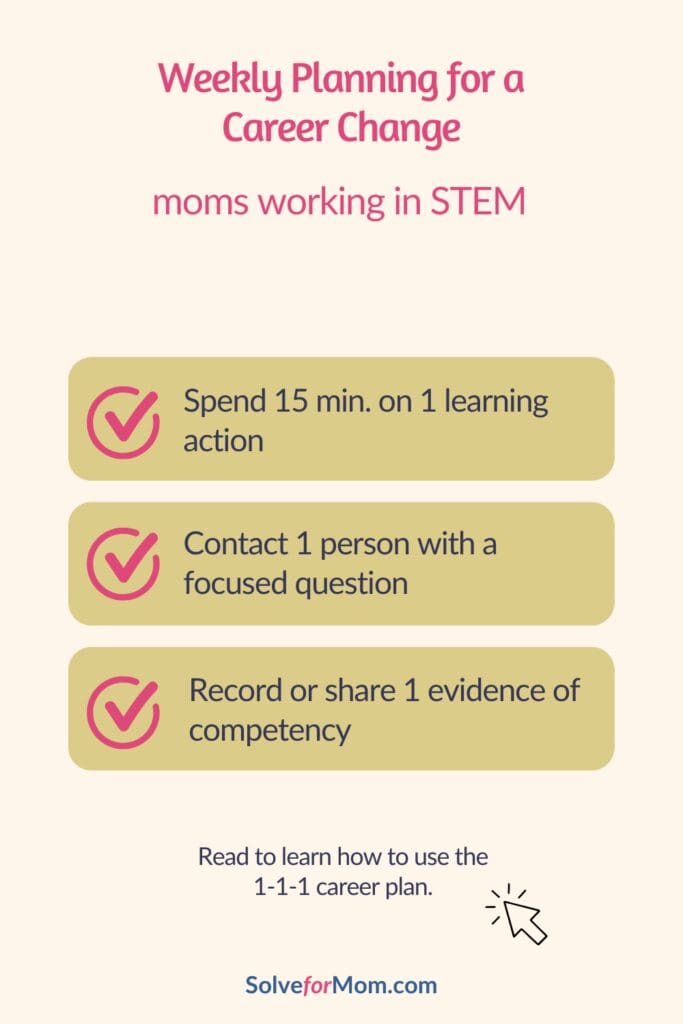
The five steps above are the full access-building path. The 1-1-1 plan below is the smaller weekly version for moms in STEM who need to know how to network when they have no time.
Use a 1-1-1 access plan:
- One learning action: Spend 15 minutes reading, watching, or analyzing one useful resource.
- One message: Contact one relevant person with one focused question.
- One milestone: Create or record one piece of visible evidence.
You can spread those actions across the week. For example, research on Monday, send the message on Wednesday, and update your milestone log on Friday.
This pace may feel small, but small actions compound. This is the way you can to stop waiting for access and begin creating it.
Pick one access-building move to try today
Choose one, not all three:
- Translate one existing skill into the language of your target industry.
- Send one focused message to someone doing relevant work.
- Record or create one milestone that demonstrates your direction.
Success today means completing the action. It does not require receiving a reply, finding a mentor, or securing a new role.
Key takeaways
- A missing network is a starting condition, not proof that you do not belong.
- Do not discard your STEM experience before identifying what transfers.
- Learn enough industry language to ask better questions.
- Contact a few relevant people instead of trying to network everywhere.
- Create visible evidence of your direction and ability.
- Treat rejection or silence as information, not a final judgment.
- Build momentum through small actions that fit your real capacity.
FAQs about how to break into a new industry
Start by learning how your current skills apply to the industry, then contact a few relevant professionals with focused questions. Create visible proof through a project, contribution, or documented milestone so people can understand what you can offer.
If you are wondering how to switch industries without starting over, begin by identifying the technical knowledge, problem-solving, project leadership, communication, and industry-adjacent experience that can transfer. Your job title may change, but that does not automatically place you back at the beginning.
To learn how to build a professional network from scratch, begin with one community and a few people whose work is directly relevant to your goal. Ask specific questions, follow through on useful advice, contribute where you can, and stay visible through genuine progress.
It depends on the role. Some positions require specific credentials, but others value transferable experience, targeted training, and demonstrated skills. Review real job requirements before committing to another degree.
Introduce your current background, name the field you are exploring, explain why their work is relevant, and ask one focused question. Make the request easy to answer and avoid asking for a job or long-term mentorship in the first message.
If you need to know how to network when you have no time, use the one-one-one plan: one learning action, one message, and one documented milestone each week. Consistency matters more than attending every event or maintaining a large contact list. Choose actions that can be completed in short blocks and paused without losing the thread.
This plan is designed to build access over time. If you need immediate employment or income, prioritize a direct job-search and financial-stability plan while using these steps as a longer-term strategy. If you have not yet identified the field you want to explore, narrow your direction before beginning outreach. This plan also does not replace education, licensing, clinical training, security clearance, or other formal qualifications required for a specific role.
More resources to help you gain access to a new industry
- Build the relationships that can open doors → Read 📖 How to Network in STEM as a Busy Mom.
- Decide whether you need more training or more confidence → Read 👩🏻💻 Imposter Syndrome in Women in STEM: Prove-It Pressure vs. Skills Gap?
- Prepare to explain your transition to employers → Listen ⏮️ How to Explain a Career Gap in STEM Without Sounding Defensive.

Build your next career move as a woman in STEM
You do not need a flawless transition strategy before you begin. As a woman in STEM, you need a way to make your existing expertise visible in a new context. As a mom in STEM, you also need that plan to respect your time, energy, and responsibilities outside work.
Join The Better Baseline for one practical career-life integration note each week for moms in STEM.