

A More Natural Way to Network When You’re Already Stretched – Adaeze Iloeje-Udeogalanya of African Women in STEM
November 10, 2026
Overview
If you’re a mom in STEM, you may want to stay connected professionally but find networking uncomfortable or hard to fit into an already full life. This conversation is about building those connections without needing more time or becoming someone you’re not.
In episode 121 of Science Careers for Moms, Adaeze Iloeje-Udeogalanya shares a purpose-led approach to building professional relationships that fits alongside motherhood. We talk about knowing why you want to connect, what you hope to gain and can offer, and small ways to keep a conversation going.
Key takeaways
- You can recognize leadership in yourself by noticing the responsibility, advocacy, and coordination you already practice.
- Own your own style and what you can offer rather than trying to copy another successful person.
- A reason for connecting helps you choose an event, a person, or a follow-up action more deliberately.
- Trusted support depends on whom you can talk to and what kind of help you need, not simply how many people you know.
- A thoughtful comment or a relevant introduction can continue a relationship without another evening commitment.
- A new idea can begin with a small way to gather information, even when you’re used to being highly skilled in your established field.
You may already be leading in ways you haven’t counted
Adaeze opens by questioning the models of leadership for women in STEM that women are often asked to follow. If the person in the role has a very different style from yours, comparing yourself with them can make readiness harder to recognize.
“Think about what it took you to get to this point in your career. At a minimum, you exhibit self-leadership, which a lot of people don’t have.”
Adaeze Iloeje-Udeogalanya, Founder of African Women in STEM
She points to the leadership already involved in navigating work, building professional relationships, advocating for your children, and coordinating a home. The conversation asks you to notice those capabilities and consider how they apply professionally. You can develop your leadership without becoming a copy of the person who came before you.
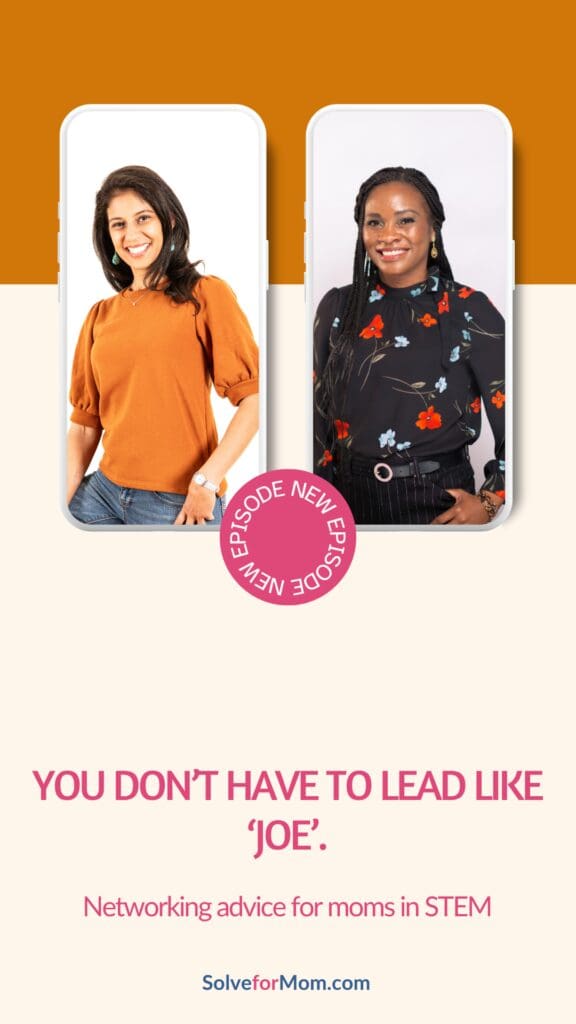
Trusted support gives you somewhere to talk about what’s difficult
Adaeze describes how trying to protect herself from criticism led her to hide parts of who she was, including her experience of motherhood. She also talks about the difference it made to have people she could speak with about the difficult parts of building a business.
“Find your people,” she says. For trusted support, her advice is specific: look for people you trust, including someone who understands what you’re experiencing or has been through something similar. That doesn’t require sharing everything with everyone, particularly when your workplace feels unsupportive.
Her career story includes international travel while breastfeeding, a toxic workplace, and a layoff that gave her time to notice interests she had set aside. She describes a gradual process of trying things, finding trusted support, and reconsidering what she wanted her work to look like.
Know why you want to connect before collecting more contacts
Adaeze knows how motherhood can bring the pickup conflict into networking firsthand. She also describes entering industry conversations where other people already have relationships and shared interests, making it difficult to join in.
“If you’re networking because someone says networking is important, you’re not going to like it.”
Adaeze Iloeje-Udeogalanya, Founder of African Women in STEM
Her starting question is, “Why do I want to network?” From there, she considers what she hopes to gain, what she can offer, and whether the people or setting fit the professional relationships she wants to build. She describes going to an event hoping to enjoy it and meet one person, rather than treating the evening as a test of how many contacts she can collect.
Adaeze Iloeje-Udeogalanya on small follow-ups that keep relationships going
Meeting someone is only a beginning. Adaeze gives examples of LinkedIn follow-up: responding to a post or milestone, and introducing two people who might benefit from knowing each other.
In one example, she notices that two people work in the same unusual niche and asks permission to connect them. That’s a useful contribution without taking on a large project. It’s a way to build professional relationships while keeping the interaction relevant to the people involved.
If you’re looking for more ways to build professional relationships around a full schedule, here’s how to network in STEM without adding another thing to your calendar.
A new direction doesn’t require being excellent from the start
Later in this conversation about professional relationships and career change, Adaeze describes how the expectation of being very good at her work followed her into trying something new. When she was preparing to build out an idea, a coach told her, “all you need is a Google doc.”
The point was to gather information before building more. We connect that experience with the experimentation already familiar to scientists: trying something, learning from what happens, and adjusting. Getting trusted support helped Adaeze question how much she needed to build first. This part of the conversation concerns exploring new ideas, not lowering scientific or professional standards.
“Failure was not an option for me. It was a matter of survival.”
Adaeze Iloeje-Udeogalanya, Founder of African Women in STEM
We close by talking about self-awareness, purpose, and alignment. Before explaining your value to someone else, Adaeze encourages you to ask who you are, what you care about, and why you do the work you do. Those questions also help you decide which relationships and career choices deserve your attention.
Questions Adaeze Iloeje-Udeogalanya answers in this episode
Adaeze acknowledges that conflict and discusses ways to maintain professional relationships outside events, including small LinkedIn interactions and relevant introductions. The conversation offers a starting point without requiring more evening availability.
The Give-Gain approach starts with your own reason for connecting, what you hope to gain, and what you can offer. Adaeze also considers whether the people or setting fit what you're looking for.
The episode's LinkedIn follow-up examples include responding thoughtfully to posts, acknowledging milestones, and making introductions with permission. These are examples of continuing a relationship, not a promise that every interaction will lead to an opportunity.
In discussing leadership for women in STEM, Adaeze encourages you to recognize the leadership you already practice and develop your own way of using those capabilities. The opening discussion includes examples from work, relationships, and motherhood.
Adaeze connects self-awareness with understanding why you do your work and what fits you now. That gives you a more personal basis for describing your contribution than trying to meet someone else's expectations.
About Adaeze Iloeje-Udeogalanya
Adaeze Iloeje-Udeogalanya is a TEDx speaker, leadership strategist, founder of African Women in STEM, and host of Lunch With Leaders. With more than two decades in engineering and energy-sector leadership, she helps women in STEM articulate their value, expand their visibility, and lead authentically.
- Adaeze’s Leveraged Relationship Guide, the guest resource mentioned in the episode
- Adaeze on LinkedIn
- African Women in STEM
- Lunch With Leaders on Apple Podcasts, Adaeze’s own show
Does your STEM job fit the life you want?
Knowing what matters to you can help you decide which relationships to invest in. Take the free Career Alignment Diagnostic for moms in STEM to identify where your career and family life feel out of sync and find a starting point for what to address first.
Listen to Adaeze Iloeje-Udeogalanya on Science Careers for Moms
Listen to episode 121 of Science Careers for Moms for my conversation with Adaeze, including her stories about leadership, professional relationships, and reconsidering a career around motherhood.
Apple Podcasts | Spotify | Other listening platforms
Episode Highlights
- (2:42) Meet Adaeze Iloeje-Udeogalanya
- (5:11) Recognizing leadership at work and at home
- (9:02) Bias, self-protection, and minimizing yourself
- (12:52) Finding trusted support
- (20:39) Traveling as a scientist mom and leaving a toxic workplace
- (30:43) Purpose-led networking and the give-and-gain approach
- (39:12) Perfectionism, starting smaller, and learning through experiments
- (46:48) Self-awareness, purpose, and articulating your value
Read the full transcript
Anokhi: Welcome back to Science Careers for Moms. I’m your host, Anokhi Kapasi. Have you ever felt like you’re doing everything at work, but still getting overlooked? Well, we all know that these days, networking is not optional. It’s what you do when you want to move from worker to leader. How you gain visibility even before you have the title to go with it. But how are you supposed to build that professional relationship when the networking event starts right when you need to pick up the kids from school? You want to keep growing in your career and have people you can turn to, but finding the time to connect is hard enough. Then there’s figuring out what to say without feeling awkward or like you’re asking for something.
My guest, Adaeze Iloeje-Udeogalanya, is a leadership strategist and founder of African Women in STEM. She knows the daycare pick up conflict firsthand, along with the discomfort of entering the room where everyone else seems to already know each other. We start off by talking about recognizing the leadership that you already practice and finding trusted people when your workplace feels unsupportive. Then we discuss how to build professional relationships when you’re already juggling work and motherhood, why connecting can feel so unnatural and where life planning fits into networking. And Adaeze breaks down her low pressure approach to relationship building. You’ll come away with a practical place to start. So this is one that you’re going to want to hit save on.
Anokhi: Welcome to Science Careers for Moms, the podcast for women in STEM who want to have both a meaningful career and be there for the important things in life. Hi, I’m Anokhi Kapasi, a PhD researcher, business owner, and homeschooling mom of two boys. I’m passionate about helping moms in science and tech build careers that fit their whole life. Join me for honest conversations with other scientists who’ve gone through the same career decisions you’re facing right now. You’ll also get actionable frameworks that cut through burnout, work-life balance myths, and circular decision-making. If you’re ready to make STEM career decisions that let you be an amazing mom, you’re in the right place. Let’s get into today’s episode.
Anokhi: Before we get into today’s conversation, if you’re wondering why your science or tech career is not fitting well with your mom life, I have a free career alignment diagnostic to help you pinpoint exactly what’s out of alignment. So if you want to take that diagnostic, go to solveformom.com/quiz. And now it’s time to jump in.
Anokhi: I’m really excited to introduce today’s special guest who speaks on many platforms about making relationship building the foundation for career success and a fulfilling life. Adaeze Iloeje-Udeogalanya is a TEDx speaker, leadership and AI strategist, and the founder of African Women in STEM, a professional network and community advancing women in STEM from experts to leaders by providing access, resource and strategic relationships to accelerate their careers. With over two decades in engineering consulting, operations and executive leadership in the energy industry, she has led large-scale projects exceeding $500 million.
Anokhi: Today, she works at the intersection of leadership and emerging technology, helping women in STEM to articulate their value, expand their visibility and step into leadership with confidence. Her TEDx talk viewed over 100,000 times, reframes cultural identity as a strategic advantage in the future of work. Adaeze is a 2026 Black Leaders Worldwide Women to Watch honoree, was named Black Impact Magazine’s 100 Entrepreneurs to Know, and is a Women Changing the World Global Awards winner. That is so amazing. Adaeze also hosts her own show, Lunch With Leaders, which is a fantastic show. It’s a show dedicated to helping women in STEM lead with authenticity and growth, create impact, and expand their influence. Just amazing. Welcome to the show. I’m so glad you’re here.
Adaeze: Well, thank you so much. I’m glad I’m here too. I’m excited about the conversation we’re going to have today.
Anokhi: Yes, it’s going to be a really juicy one. I have so many fun questions. I don’t even know if I could get through them all because I have so many. We had the loveliest conversation the other day, and it was just this little primer for everything that’s to come today. So yeah, I’m pumped.
Adaeze: Me too, me too.
Anokhi: Okay, is there anything that you wanted to add to that bio?
Adaeze: Oh my goodness, I suppose, like, is that me? Okay. Thank you so much for the intro. It was absolutely amazing. And yeah, no, I don’t have anything to add, I’m excited.
Anokhi: I know you are a person that helps women advocate for themselves as they embrace that leadership position. And I think it’s really cool that you were just sitting there and you’re like, wow, somebody’s doing this for me, highlighting that I’m a leader. Okay, let’s just get right to it. A lot of moms in STEM are leading everywhere, at work, at home, in their communities, but they may not actually see themselves as leaders. So how do you help women expand that definition of leadership when they find themselves in all of these roles?
Adaeze: That’s interesting. This is what I deal with, not deal with, but I encounter this all the time. Within my community, with the clients that I work with, and that’s another reason I said African Women in STEM, because typically most women in STEM are smart. You have to be exceptional to survive and to prove yourself every single time because you always get the questions, what are you doing here? So technically, they’re exceptional.
Adaeze: Now, the problem now comes to you start your career, and at some point, you want to take some leadership positions, and then all of a sudden, the doubt comes in because the example of leadership that we see is not the kind of leadership that we showcase, right?
So typically, if you’re in a male-dominated field, most of the leaders are going to be male, and their leadership style is going to be very different from yours, and then when you want to step into these roles, they’re going to be told, okay, be like XYZ, but you’re not XYZ. So when I hear this, what I say is like, oh, I’m not a leader, and then when I ask them why, or I don’t think I’m ready, and when I ask them why, what they do is they describe an example of leadership, that’s usually a man in that role that they’re trying to step into, and they feel that they have to be like that person.
Adaeze: And the first thing I say is, first of all, you cannot be, let’s say Joe, you can’t be Joe, okay? First of all, even if you try right now, you can’t be Joe. You can go change yourself and come back, you still won’t be Joe. So you shouldn’t try to be like Joe, one. And then you’re already a leader.
Adaeze: Think about what it took you to get to this point in your career. At a minimum, you exhibit a self-leadership, which a lot of people don’t have, because you had to show up every day. You have to be resilient, you have to be strong, you have to be excellent, you have to be exceptional, you have to do 10 times more to get half of your permission. That in itself is a major part of what it means to be a leader.
Adaeze: Then also go back and think of the relationships that you had to build, because realize that you have to survive in environments that are not set up for you, means that you have to play a very interesting, it can’t just exist. You have to strategize every single time. How am I going to show up at work today? How am I going to have this individual? How am I going to say so that they don’t misunderstand me? All of that, that’s leadership right there.
Adaeze: Let’s talk about the home part. You’re a project manager in your home, you’re probably a Chief Financial Officer for the most part. You’re managing budgets in the counter, in the CPA, you’re advocating for your kids. So like your kid advocate, you’re doing the marketing because you’re talking about your family, your kids and how wonderful you are and why you should get that home, and why your kids should go up a grade and not go back.
All those things, just think about all of the things that you have to do. Then in your own family, probably to your siblings or your parents, you’re taking charge in so many ways. So you’re doing it already. So just a matter of how do you not separate your life from your work, and how do you also elevate the things that you do and realize that you’re made, really. You just have to transfer all of those things to whatever you’re doing, whatever you want to do in the next level of your career. I just have a little bit more to finish it. Yeah. Yeah.
Anokhi: Yeah. That’s really interesting. I never thought about it as requiring strategy, especially the relationship building part. But you’re right. The interesting thing is that to get to where you are, it required excellence. If you’re ever in doubt, there’s a whole list of credentials behind your name to back it up. But it sounds like it’s not just the excellence that you show in career that you’re talking about, that there’s everyday examples of excellence, or even things that happen professionally, that we don’t think as professional work, like the relationship building part. I just always kept that separate. That’s really interesting perspective.
There’s this tendency, I know I’ll speak for myself, but I think that this probably happens for a lot of women in STEM, especially when you get into motherhood, is the further up you go in your career, kind of minimizing what you’ve done. Are there specific signs that we should be looking out for when we find ourselves maybe going down that hole? Because it sounds like that would be contraproductive to presenting yourself as a leader, right?
Adaeze: Yes, it is. Again, you talk about your example, I’ll talk about mine as well. I worked for a lot of years before I got married and had kids.
Adaeze: The part about minimizing yourself is not so much, again, I grew up with, my mom worked all the time, all my aunts worked, they were professionals, they were professors in universities, teachers in colleges, they were lawyers, all those things. The whole idea of a woman having a career, it wasn’t even something that came up, it was just life. When I was single, it didn’t really come up because again, I was too busy doing all kinds of things, I just working and all that.
Adaeze: But by the time you get married, it just starts coming up in a certain way that, why do you want to have a career? Why do you want to still have a career? Why are you still doing it in the workplace? Shouldn’t you be at home? Then I started to think things like, in the industry, I worked with a lot of the men. Their wives were either staying home or they were working part-time or they had careers that made it possible for the man to show up fully. Me being here is like, what are you doing here again? I don’t understand. One.
Adaeze: Then two, people have conversations around me about how their wife has to step back and all of that. Well, first of all, I am the wife in this situation, so I don’t know what we’re having this conversation, what are you trying to tell me? It’s being passive aggressive.
Adaeze: The part about minimizing yourself just comes from all of a sudden, they start viewing you differently. There’s conscious bias and unconscious bias. Whether I like it or not, some of these things start coming up.
Adaeze: I remember going to see my brother once. This guy was like, okay, my daughter was maybe like eight months at a time. So the guy was like, so what does your sister do? So he was like, oh, she works and now that she works, shouldn’t she be home taking care of her child? She’s a mom now. So it’s almost like people feel like they have to tell you what to do or where you’re supposed to be because you’re a mom now.
Adaeze: So the idea of being a bias is almost like when you get all of this information and all of this coming at you, for me, it was more like I’m trying to protect myself. So the less of myself I expose to hurt, the better. But then it didn’t help me either way because it’s like I’m showing up, but I’m not showing up fully. I mean, I’m saying this because this is like hindsight is 20/20.
That’s what my TEDx talk was all about because in trying to protect myself, I hid myself so much that I wasn’t being myself fully and it bothered me and it affected my relationships and everything that I did because I always felt like something was missing and I didn’t know what it was. But when I found out what it was, it was just because I was trying to protect myself to the extent that I just literally hid everything that made me incredible because I did not want to expose it to attack.
Adaeze: The thing to watch for and I think knowing what I know right now, it’s more like having those conversations more because again, it’s very different for men than it is for women. Because I remember my husband had a job at the time and they wanted him to, he was an attorney, they work on his crazy hours. But he lived in New Jersey, he works in New York. They were like, why do you live in New Jersey? He was like, well, my wife. They were like, tell her to quit her job and just move. I was like, really? Why are you making that kind of decision for a woman that you never met, you don’t even know? But they felt justified in saying that.
Adaeze: So you’re getting it from your workplace, you’re getting it from your husband’s workplace that you should make all the sacrifice and all that stuff. So it’s just good to watch out for that.
Adaeze: Also, one thing that I didn’t do very well, which most women don’t do is talk about it because again, culturally, you’re supposed to be a good mom, a good wife, you’re supposed to love your children. You’re supposed to absolutely love everything about this new life. So if you talk about how it’s a bit challenging, oh my goodness, you’re the worst person ever.
Adaeze: So I’ll just say, have those conversations, find your people. By your people, I mean somebody that is experiencing the same thing or somebody that has experience, that made it, that you trust so they can actually have those conversations. Talk about what’s really happening, what you like, what you don’t like. I didn’t have that. And that was literally the thing that made it very difficult to process.
Adaeze: But right now, I talk more than anything, okay? Because I’m building a business now. It’s not something I’ve done before. It’s really hard. But what’s making it easy is that I have my support system. I have people I talk to about it, about the good, the bad, and the ugly. I just call my friend. I’m like, I hate everything I’m doing right now. I want to run away. And they will talk about it.
Adaeze: So I’ll say, don’t feel like you have to keep it all together. Don’t talk to just about anybody either, but just take time to find at least a couple of people that either talk to them to release stress or talk to them because you know they’re going to tell you something that will elevate you a little bit. And at a minimum, convince you that you’re perfectly fine and everything you’re doing is okay. So you need to eat all of that.
Anokhi: Yeah. No, I think that’s amazing because I think you pretty much hit on the spot why both of our businesses even exist in the first place. It is to start changing that conversation because you’re right. I think a lot of that minimization or what you should or shouldn’t do is coming from others. We hear the comments that other people are making or, as you said, in your workplace, it was, I mean, industrial engineering, I can imagine. There’s a lot more men and so they’re talking about their own version of life and success. And if they talk about women, it’s really, they’re talking about their wives.
Anokhi: And so there was that sort of mismatch in lifestyles and priorities and how the workplace sort of welcomes you in. I like that your answer is really an empowering one. It’s to just take charge and create the new conversation. And also visually our models might be different.
Anokhi: You know, I was actually in a very different situation. I was lucky. I had a lot of great, strong women models and mentors. As you did within your home and family, where you’re like, oh, this is just normal to be a mom and working. I didn’t necessarily have that fully in my family life, but I did have that in my training. Through my training, I saw many women who were doing both. I was able to take the opportunity to see what I liked or didn’t like about the choices that they were faced with and how they made those choices.
Anokhi: A lot of the women mentors I had chose one side or the other of career or family life and not necessarily both. I think just changing how you show up, you become the new model for normal as well as the conversation.
Adaeze: Again, I always say hindsight is 20/20, but when I started African Women in STEM or started mentoring, my entire life, let’s just put it that way, you don’t have to go through the same experiences to learn something. There are some experiences that not everybody should have. I remember when I was working, there was this whole thing. Again, to your point, there are not many women in my industry. That’s just the way it is.
Adaeze: But the few that there were or in certain industries, what I do hear from people is, there’s this belief that if I went through this, you should go through that too because that’s what’s going to make you tough? And I’m like, why? The men don’t do that. See, the first person went to something, they’re not expecting everybody else to go to the same thing. They make it easier. Open the door, they give themselves grace. I understand that you think you’re doing the person a favor, but you’re really not. Like, why do I have to go to the same pain that you went through to make me tough?
Adaeze: And now, knowing what I know now, it kind of goes back to, we go through things and we don’t have the opportunity to express that. So we hold it all in. Before COVID, I didn’t know what therapy was, okay? Now, I feel like everybody needs therapy because there’s some things that you have to walk through. Going through pain, holding it in, and thinking that everybody has to go through that pain is not healthy. That’s something you need to walk through, but we don’t walk through things because, again, that’s also a sign of weakness. You’re not supposed to show weakness and that’s not going to tell you. You have to come up and be strong.
Adaeze: I want to be myself, but it’s also difficult to be that because I remember, I actually started dressing differently because I dress nice. I’m an African-Nigerian, we overdo things. I was just talking to my sister the other day. This is a face she didn’t think about when she was in Nigeria, she just layer the lipstick on because if you come up, everybody else has layer lipstick. So nobody is going to look at you and think you’re lipstick is too much.
Adaeze: A colleague of mine that was like she wore a skirt to work with her, people kept coming to her office to ask her questions. They were not coming to ask her questions, they were just thinking, oh my gosh, you wore the skirt. So things like that, all of a sudden you start dressing differently because you’re trying to take attention away from yourself. It’s really a difficult place to be in. So why would you tell someone, I went through that, it wasn’t fun. So why would I expect someone else to go to the next, I mean, there’s some things that don’t make sense, but I also think it’s just a case of if you acknowledge the things and realize that you need to walk through it.
Adaeze: Always, I believe in the power of community, that you can support each other and make it easier. I don’t know how the industry is right now, I’m not there. But in the 20 years I was there, not much changed. If nobody’s fault, because again, the men and the majority, when they have women in power, sometimes it’s really just for the optics. There’s always someone that makes the rules, that is not even the woman, that probably even reports to the woman, something like this, and that person is going to be protected.
Adaeze: You find that you see somebody that is like an SVP or a director, or like the head of a whole unit saying things like, I have to watch what I say, even to people that report to her. Because in that room, there might be 30 people, or 30 women, and guess what’s going to happen? What does she mean well or not? Whether that person is a basic or not, they’re always going to stand behind a man. So it’s a very difficult place to be in.
Adaeze: I know sometimes people that when they don’t have that exact same experience, I was like, listen, don’t minimize other people’s experiences, it’s a really tough place to be. I don’t know if you understand what it means to work for 30 years, be at the top of the company, still not be able to express itself. Because somebody that reports to you is going to get offended. Because your tone wasn’t what they expected.
Adaeze: So it’s a whole thing, but I just feel like if you get there, if you survive, make it easier for the next group of people. And also in general, we need to work together more, especially in industries where there are not that many women.
Anokhi: Yeah. And I feel like there’s so many examples of this with other social cultural problems that we’ve had in the world through history and whatnot. And I feel like that particular model of community, talking about it, therapy, all those things have, we have example after example where that has changed the norm and has improved the world for the better. And so I feel like, yes, we were definitely onto something because something has to change in terms of our STEM workplace and just making it feasible, especially like, yes, women, but, you know, I’m really focused in on the woman who is also a mom. And I think there’s that extra layer of sort of tension or being sort of offset a bit.
Adaeze: Yeah.
Anokhi: So now tell me, it sounds like maybe you had this moment where you finally decided, okay, I’m going to change things that I’m going to start advocating for myself. And I don’t want others to decide for me how to be myself. And I loved what you were saying earlier about being your authentic self and that when you do that, then your incredible part of you is going to come out. Like that’s how you can show how incredible you are. So it sounded like at some point you made this switch. How did you do that and really what happened after that?
Adaeze: I tell the story that I was like, listen, it took me six years, okay? That’s the reason why I talk about it so it doesn’t have to take you six years. So again, I’ve always known what I wanted to do. I’ve always kind of walked towards that. I’m going to change my mind here and there, but in general, I always know where I’m going. And I think as I got older and more into my career, for some reason it was just one of those things that I’m like ten steps ahead, okay? Like this is what I’m doing, this is where I’m going, this is how it’s going to work out, and so on and so forth.
Adaeze: So again, back to what you’re saying about being a mom as a different layer. For example, when I was single, I always used to kid that I had my bag packed. And usually when they say you have to go somewhere, I’m at the airport before I ask them, where am I going again? Now, when you’re a mom, you can’t do that, all right?
Adaeze: So I had to travel out of the country. Actually, in my industry, I don’t know why, it was just a very bad habit, where clients never make up their mind until last minute. And then you find out that you have to travel, and you just have a couple of days. So I’m going to travel internationally, I have a couple of days, I’m breastfeeding, and all of that. And I had to go read up the rules of that country, how much breast milk they’ll let you carry, how you’re supposed to carry, everything was ridiculous. This is something that I wouldn’t have worried about when I was single, and this is something a man definitely will not worry about.
Adaeze: So again, back to like, what did I do?
Adaeze: So I kind of got to a point in my career where, because I was like going for it, going for it, okay? Because this is what we do. And I was literally getting ready to outsource my entire life, so that I could give 1,000 to 7,000% to work. At that time, I was working at a very, very toxic place. It was so toxic, it was ridiculous. But I told myself, oh, no, they didn’t just know me. I mean, they need to see. And again, the Nigerian in me will not let me quit because we don’t quit, we’re not quitters. We make it work, we push through everything and da, da, da, you know.
Adaeze: Eventually, I was laid off. And it’s so funny, I got into the car, I called my husband, I was like, is it weird that I’m happy? He’s like, of course it’s not weird. That place is terrible. Like, it’s a terrible place.
Anokhi: I mean, I can imagine it takes like a mental, a physical toll on you. And even just professionally, I mean, how if it was that way, how can you shine professionally even, you know?
Adaeze: So I can imagine.
Anokhi: Yeah.
Adaeze: It’s impossible. It’s impossible because I remember. I don’t want to go into that because there’s a lot going on with toxic workplace.
Adaeze: But back to what was the moment, it wasn’t really a moment, but then that was the beginning. But the thing is that before then I was already feeling like something wasn’t right. Again, back to, I was doing all this, I’m not realizing that I was just cutting off, almost like cutting off your circulation in a sense, right? So there was a level of discomfort, but my response to that was doing more.
Adaeze: But after I lost my job, one of the things I told myself is, first of all, I don’t want to work in engineering consulting anymore. It’s so toxic, it’s ridiculous. I’m a mom and I wanted to have more control over my time and have more involvement in my kids’ activities. It was very difficult because when you’re looking for a job, it pays more and the participants keep coming and you’re looking at the pay. It took a lot to tell myself, no, we’re not doing this because they’re all the same. I worked at different companies and I had clients, so I know there’s no difference.
Adaeze: But it gave me time, so it took a couple of months, I finally got the job that I wanted. But in that time, it’s like, first of all, I had to take a walk. I’ll be walking down the street and I’m an ideas person. Before this, I was a writer and I didn’t write for a long time. But ideas kept coming to my head like business ideas, writing ideas. I felt like, oh my goodness, where was all this stuff this whole time? How did I lose this? And I never wanted to lose it again.
Adaeze: So that was basically, I was like, what if I’m doing, it’s not going to block this part of my brain and just suppress it. At first, I didn’t even know it existed anymore. It didn’t even come up in so many years, almost over a decade I was working. So I just knew I didn’t want that to happen. So that was where I started. I was like, all of this exciting things.
Adaeze: And then I started leaning more into the things that I love, like I’m very creative and so on and so forth. So that was when it started. And the more I leaned into the things that excited me, I love to build a relationship, I never had time to go anywhere. I love to do this, I never had time to do that. So I started getting more involved in little by little, because it’s not that easy to just start and do things all of a sudden.
Adaeze: And not that it went away, because further down the line, I had to hire a coach. I just figured out that coach was a thing. And I was like, I’ve done everything I can, I’m still uncomfortable like this. This thing, I felt like there’s something missing and I just couldn’t figure it out. So I felt like having someone say, I met this lady, it was a virtual conference, I absolutely loved the way she spoke and hired her. And she also helped me ask the kind of questions that got me thinking. And then, of course, I fought her all the way, because like, what do you mean?
Anokhi: And things like that.
Adaeze: But it was a journey. And part of the reason why it took me a whole six years was also because I was fighting because I was like, but this is what I did, but this is what I planned my whole life. This is what it should be. Now if I do this, what are people going to think?
Adaeze: At the end of the day, it was more like, I felt that people are going to think, because the biggest thing was, okay, so you do all this stuff and they throw it away. So all this school and then you’re doing what again? Because I really wanted to go into fashion. You know, it was very close. But I was a lot of working on myself.
Adaeze: But the more I kind of got into myself, the more I realized that I really love doing what I love. And I also have a lot to bring to the table.
Adaeze: And again, you know, this whole idea of showing up to work, the way the workplace works, at least most of my career was in America, the way the workplace works is almost like, there’s this hierarchy with employer and employee. You feel like the employer is giving you this amazing thing, you’re just there, oh my goodness, please look upon me, I have mercy. But if you had nothing to offer, you wouldn’t be there in the first place. But the way the mindset works, they make you feel like, okay, at least thank God I have a paycheck, thank God I have a job. No, you are also offering something. In a way, you offer your services, you’re a business person just that you have one client.
Adaeze: So that whole mindset, okay, so I have things to bring to the table, this is what I have to offer. I wanted the relationship to be more of mutually beneficial, like I bring something to the table, and we work together. So it wasn’t like this thing of, I owe my life to you because you’re giving me money. You’re not giving me money, I work for it, probably too much. So it was a process really.
Adaeze: But it’s like every day, one of the things I did was, I got, apart from the coach, I actually got a lot of help. I did some masterminds with some people. It was so hard for me because I got to a point where I needed to know everything. I was a risk manager at work and in my personal life, and I had contingency plans for everything that I planned for, the unknowns, and all of that.
Adaeze: But just learning to let go, stop overthinking, and just learn to let go of perfection. It was a process, but that was just basically it. The more I did that, the more I actually started to enjoy life, and living, and I didn’t want to go back. It doesn’t have to take you six years.
Adaeze: But one of the things I will say, which really worked for me is, when I reach out to people for help, when I hired a coach, when I joined the mastermind, I was open to listening. Not that I didn’t always do what they told me the first time, but I was like, if I’m here, there’s a reason. If they say something, I should at least lean into it. I mean, what’s the scenario? I’ll be like, oh, okay, well, this is what for me. Best case scenario, oh, this actually works for me. It’s wonderful. Either way, I would have learned something about myself. That’s what I’ll just say.
Adaeze: Just don’t do it by yourself. I mean, I’m going to say it again. You hear this all the time. I say it all the time. Just find the trusted people, be coachable, be open to trying the different thing or the new thing that they’re telling you that will work. Because you always learn something in the process.
Anokhi: Yeah, your story is so relatable because in so many ways it overlaps with the women that I work with and my own personal journey. I went through something very similar except for I wasn’t coming out of a toxic environment. It was just that as I took on the motherhood role, I was feeling this pull in both ways. But it also took me a couple years and pretty much the entire basis of my business is to help women navigate through that change, that process, find that new path. And so I love your story.
Anokhi: I just wanted to point out that you don’t have to be in a necessarily uninviting or toxic environment to also go through that sort of mind shift that, hey, I want to have more freedom or I want to have this. And how can I make this so that it is this give and take sort of situation? Because you’re right, we have so much to offer and we don’t always see it that way.
Anokhi: And I loved that you just going out to take a walk was this floodgate of ideas and it reminds me of Cal Newport. He talks about deep work and one of his strategies he talks about is going out for a walk, going out in nature, not keeping anything techie with you because that’s what happens. You just, I mean, you can have pen paper if you need, but all these ideas come to you. So I love that that was kind of your journey as well.
Anokhi: So you were talking about how building community is, was something that was really important to get you through this process. And part of that is building relationships. But many STEM moms hear that word and they think networking and they immediately think, oh, I don’t have time for that. I’m already so swamped or I don’t know how to do that. I don’t know. This feels so fake, you know. So how do you suggest that they approach relationship building so it can feel natural and authentic?
Adaeze: Yeah, I mean, everything you said, I explained the same thing. Normally, like from when I was a kid, relationship building was a thing that I did. But somehow when I found myself in the workplace, and then when I became a mom, I became too busy to build relationships. And it made sense, oh, I don’t have time to do that, I don’t have time to do that. Of course, after hours, what do you call it? Cocktail, whatever I call the thing that you do in the evening. After work. Doesn’t work because I have to go pick up my kids when they can. And it just seemed to make sense.
Adaeze: And then also the part about networking being inauthentic, I mean, I explained some of that because I really go out to look for and find my people, and I go to all those events or conferences, I can always say you get together with people and they’re talking about hunting and fishing. How am I supposed to be able to have this conversation? So you just keep quiet and listen.
Adaeze: So there’s something I heard recently that made it make sense. They were like networking events were not built for women. They were built for, actually, in male-dominated spaces. Because some of these men, like when you show up to these events, most of them already know each other because they either hunt together, fish together, drink beer, and watch games together, which are spaces that you cannot be in by virtue of the fact that it may not be safe for you or it’s just not the thing, or you’re busy taking care of your kids. When they show up to these conferences or whatever, for networking events, they already have a relationship. They continue those conversations and you are trying to come in to meet new people and they’re really not for it. You’ve already failed even before you step into the room.
Adaeze: Networking, yes, it did feel like, whatever I say networking, it did feel like inauthentic and crammy, but I did it because I was hoping to find my people. What I say, what I’ve learned now, which I’ve always known but I forgot about it and I’ll do it again, is when someone asked me that question, I was talking about how wonderful it is and I just realized that the difference between now and then, is I’m not really in places that I don’t want to be. Most of us don’t have that option because your work can send it to a conference and it can send it to an event.
Adaeze: So either way, the thing to do is like, why do you want to network in the first place? Because if you’re networking because someone says networking is important, you’re not going to like it. If you’re networking because you need a job tomorrow, you’re going to be too anxious to actually build relationships. If you’re networking for any other reason besides a reason that you determine for yourself, it’s not going to be an enjoyable experience.
Adaeze: So first of all, ask yourself, why do I want to network? Why? What are you looking to gain from networking? I meet someone, then what? Because again, you can meet people, collect a bunch of, now LinkedIn is the thing, so collect a bunch of LinkedIn, collect a bunch of people’s LinkedIn, and never talk to them for the next 10 years. What’s the point? So what do you want to network? And then the people you’re networking with, are they your people? So it goes back to why do you want to network?
Adaeze: And then one thing that people always forget to do is think, what do you want from them? But also, what do you have to offer?
Adaeze: So I’m going to say, if you’re in a situation where you can pick and choose where you go to network like an entrepreneur, for example, I mean, we do it because we have to, you have to build a business and build relationships. But again, you don’t have to be in a place that makes you uncomfortable. You have that choice.
Adaeze: But if you don’t have a choice, I just have to go to industry events regardless. If you find out why you want to network, I want to, and I’m going to give you a reason, which I think should be your start. I want to build relationships with people that are like me. That’s a very simple reason. Either like you in what sense, maybe you’re so into whatever your work is, I want to find people that are so into that thing and think the same way you think about the problem. Maybe that’s it. Or I just want to get to know more people in the industry. I want to build a relationship. Whatever is have their reason.
Adaeze: So that when you go into those networking events, somehow you don’t need to talk about training your brain. Whatever you tell your brain, it believes it. So you tell your brain, I’m looking for somebody, let’s say I’m a neuroscientist that specializes in something nobody cares about. I don’t know. I want to find that person. You’re going to find that person. But because you’ve already told yourself that, and then you find out what are you looking to gain.
Adaeze: If I go to a networking event, usually what I tell myself is, one, I’m going to have a good time. At a minimum, I’m going to have a good time. And if I meet one person, that is absolutely incredible. And guess what? Every single time I go, I meet more than one person. And not just more than one person, I meet the people that I feel like these are the people I’m supposed to meet. But going in there with zero expectation makes it so much better.
Adaeze: Like that’s what I’m saying, the best time to network, maybe it can help if you’re looking for a job, but usually if you’re anxious about something, or you have a lot of expectations, say I go for a conference, I want to get a job, I want to meet someone, I give them a job, I don’t love that. It’s not going to allow you to actually see the people you’re supposed to see or enjoy the experience.
Adaeze: So always go with, you know why you want to network. Because I leave the house, sometimes I tell my husband, I’m looking for money. I say that, but my expectation is, I’m going to have a good time or please I meet one person. I always get blown away every single time because there’s no pressure anymore.
Adaeze: So I go to the event and I’m relaxed, and I’m ready to maybe the good time is listening to someone or eating the good food. If that’s all I do, I’m fine. If I meet one person, I’m fine. But I end up going home with three connections that years down the line, I’m like, I could never have mapped this out if I had done it myself. Just do that. That will just make it easier for you to get to know people.
Adaeze: Also, when you meet these people, exchange LinkedIn address and all of that, again, that’s why you have to know, why am I doing this? What am I looking to gain? Then also, what am I looking to give? If you meet someone because you don’t know what you want, you know, okay, this person is probably the person that’s going to get me where I want to. That’s why I’m looking to gain.
Adaeze: When you collect all those LinkedIn addresses, LinkedIn makes it so easy. They remind you it’s their birthday, they change jobs, blah, blah. I always just say something. If they’re active on LinkedIn, like their posts, something just at least once every couple of months, keep in touch. And then what do you want to gain? It’s going to come. And then what do you want to give?
Adaeze: So like I do things like when I meet somebody, I’ll be like, oh my goodness, this person, like I met somebody that is in like food. I can’t remember what it is again. But the niche that they are in is not something I’ve heard before. And then a couple of months later, I meet somebody like that same niche. I was like, these two people have to know each other. So what I did was like, hey, I just met somebody that’s in this. Do you mind if I introduce you? And they’re like, no, sure, go ahead. I did that. Whatever comes out of that relationship, it doesn’t matter.
Anokhi: So you also can become the facilitator. And so it’s not just connections for yourself, but it may be that you’ve met this person because you’re meant to connect them to this other person. Yeah, I love it.
Anokhi: So on one hand, you can let these platforms like LinkedIn, leverage them as best as you can, but you can be a human version of LinkedIn as well. That’s amazing. I love the gain and give sort of reframe as well. Everything you said is so useful. Thank you.
Adaeze: You’re welcome. It’s really easy if you know what you want, have an expectation and also come from a place of giving.
Adaeze: And I see this on LinkedIn, I have friends, people always come to me and ask me, I want a job, I want a job, I want a job. And then somebody might come on and be like, look at that, I like the post you had the other day. And they’re like, it’s that simple. It was that simple to get her attention. You know what I mean? Like it’s so easy.
Adaeze: The giving part is really very easy. You know, if you’re busy, you’re a mom, you have everything, you don’t have time to do too much, but you can like somebody’s post. You can comment on their post, you can wish them a happy birthday, you can connect them to somebody, just little things. And people appreciate that. And if you need something tomorrow.
Anokhi: You’re on their radar.
Adaeze: You will get it. Sometimes they’ll be like, is there anything I can do for you? I’m like, when people tell me, I’m like, are you sure? Because I have a lot of things that I want you to do for me. They’re like, sure. You know, so just have fun with it, you know what I’m saying?
Anokhi: Yeah, I love it because you made something that feels really intimidating, you know, to me, even with years of practice to all of a sudden, I feel like this is going to be really easy. So I’m really excited to try out some of the things that you’ve been talking about. I want to get a little more practical and even mom friendly, if that’s possible.
You’ve been giving us some great insight already, but earlier you were talking about you stepping away from the work and industry that you had even trained to be in and evaluating what it is that you wanted and going for that, you know, how taking in these passions that you had and making it a new career. What do you think the biggest barrier is that stops women from having that career, especially coming from this technical background, one that they truly, truly want?
Adaeze: I’m going to say what it is for me and what I think it is for most people because I work with a lot of women. We, the desire to be very good at whatever it is that we’re doing next, almost perfect. Because if you think about it, in STEM, in the technical career, most of us have graduate degrees, masters, PhDs. Even if we had 100 other students that were male, we’re probably top five. I mean, we have to be.
Adaeze: And then at work, it’s, as I think about it, one of the things that I worked on, it’s almost like, they say that women are, they have a different diagnostic which they are measured, and that’s true. Funny enough, I used to think the first, thinking back, I thought it was a compliment, but now I’m realizing it’s almost like a setting up to fail. Because every review, they’re like, you’re way ahead of everybody else, we have to raise the bar for you because, you know, you’ve already done more, everything and more than we expected. So it’s kind of not fair to you. And when I was thinking, oh my goodness, I’m better than everybody else.
Adaeze: But what it means is that, okay, let’s, because this is audio. So let’s say you have a stick that is like 10 feet tall, everybody is supposed to jump 4 feet. And then one year you’re jumping 6, next year you’re jumping 7, 8, 9, 10, everybody else is jumping 4 and 5. That’s what it was.
Adaeze: So again, so the idea of being really good at what you do, it’s something that if you’ve worked for so many years, and if you’ve gone to school for so many years, it’s in you. So when it comes to doing something new or different, somehow for me at least, and a lot of women, we believe that we have to be really good at it from jump.
Adaeze: I think entrepreneurship really, right now I’m having so much fun with, I don’t know what I’m doing, I’m absolutely failing, but it’s fine. But it was hard for me to do.
Adaeze: Back to what I said about, find your people. I know what I know. Even when I was in college, if I’m studying something that is not making sense, I’ll go find somebody that has figured it out. I’ll be like, okay, you study that, I’ll study this, we get together. I guess when we get together, it will take in an hour, I’m good. Meanwhile, if I’d done it by myself, I’d be working a whole week.
Adaeze: One of the things that happened, because I remember I was trying to build out this whole thing, because again, you have to show up in my mind, you have to show up with this best thing. I didn’t work in tech, so I didn’t understand the whole thing about minimum viable product and whatever. I worked at industry that was over 100 years old, so everything was already done. It had to be perfect.
Adaeze: So I was part of this program. I did coaching calls twice a week or whatever. So I joined and I was like, so this is that and that and the other one. And she was like, listen, all you need is a Google Doc, that’s it. I was like, what do you mean? Because I was trying to build out this whole thing. She was like, don’t build anything because you don’t know. Just get information. Nobody needs that. She was like, I mean, my first business I made a mistake, I’m never going to make that mistake again.
Adaeze: Sometimes you feel that we need more than we do. So I think the thing about showing up and being not perfect, a little bit imperfect, not completely prepared. With this product that still has like threads coming out of everywhere, is the thing that holds us back the most.
Adaeze: Then the fear of failing, which I know where that comes from. Because I was doing exceptionally well at work, they still found reasons to do what they did when they chose to. Failure was not an option for me. It was a matter of survival.
Adaeze: So for a lot of women in STEM, especially if you’re a mom, failure is not an option for you in work and in life. So you carry that into the next thing you want to do, and you think it cannot fail, it has to be good. It doesn’t have to be good.
Adaeze: If you give yourself grace to, I have no idea what I’m doing, I’m going to do it anyway. Guess what? You will have fun in the process. It’s really because you can laugh at yourself. That’s what I’m saying, learn to have a little bit of fun.
Anokhi: Yeah.
Adaeze: I mean, it took me a long time to put things out there, because I remember, you have to put stuff out there. But the moment I got over that, I put stuff out there, it doesn’t work, and move on to the next day. I put it out there, it doesn’t work. Right now, I don’t care if what I put out there doesn’t work. What it means is that I’ve done it, it doesn’t work. Now I know, I can move on.
Anokhi: Actually, as scientists, we’re all really well-trained in doing experiments, and it feels like, come on, that’s such an unreasonable expectation we’ve placed on ourselves to start something new and expect to be a master at it already. I mean, even in our own original field of training, that was not the case. We had years of perfecting, failing. Do you know how many, like my PhD was four and a half years of failure with a year and a half where finally things were clicking, right? It’s the most humbling experience. You’ve gone through that.
Anokhi: Of course, if you’re going to start a new venture, a new idea or take a turn in your career or even shift slightly to it, all those things you cannot expect to be perfect right off the bat. But we hold ourselves to that expectation. But you’re right.
Anokhi: The thing that we have to remember is that you might not be perfect at it right now, but have faith in yourself that you can learn it. You’ve proven that to yourself over and over again.
Anokhi: That’s what I’m always telling myself. This is an experiment. Did it in my PhD. I can do it here. It may not work, but I’ll figure it out. Everything is learnable. I think that that is exactly what you’re describing too.
Anokhi: There’s so much humility that comes with it, but part of that journey, as you said, is showing yourself grace, and being lighthearted about it, and laughing at yourself at the failures. It’s such a human way to proceed, rather the infeminine way too, with these nurturing yourself along the way, rather than that hard cold version that we sometimes find ourselves in, that environment. So it’s amazing.
Adaeze: Again, you don’t have to be like me because I had to. The whole idea of overdoing, I completely burnt out if I figure things out.
Adaeze: But giving yourself grace, so I think because two years ago, I’m always ten steps ahead of everything, and for some reason, I could leave for good. I knew it wasn’t my son’s birthday, but I could leave for good. So I did not get him again. No one would be like, we’re leaving, could have, would have, should have, why did I didn’t sign, when would I have remembered to buy the gift so that it wouldn’t be.
Adaeze: He came up to me and immediately I was like, oh, because it was a weekday. We were going to celebrate his birthday on the weekend as a family. I was like, yeah, you see, I just didn’t want to do it today because I was thinking that we will do it on Saturday. I was like, oh, okay, cool, thanks.
Adaeze: I went out and I bought two gifts to make up for it, but I was so proud of myself. Because before I would have had to beat myself up for maybe months even, which doesn’t make any sense.
Adaeze: The whole idea of giving yourself grace takes practice. However, when you get there, it is so much, I had so much fun with that. I was like, oh my goodness, I can’t believe I made stuff up on the spot. I had to buy two gifts to make it up. It was fun, I just laughed about it.
Adaeze: And he was fine, okay? He was perfectly fine. He got two gifts instead of one. He didn’t even know he was supposed to get one. But it can be that simple.
Anokhi: Kind of getting to the meat of it now, where you are helping women in STEM articulate their value. And that’s sometimes really hard to define, especially when you’re doing it for yourself, right? And in doing so, they can then step into leadership with confidence. How do you do that? What does that actually mean? How do you do that to articulate your value?
Adaeze: I love this so much. And I did talk about it in my TEDx talk too, because again, it’s one of those things that you just kind of learn and you’re like, ooh. However, to articulate your value, first of all, you have to know who you are.
Adaeze: Because I know for the longest time I work, you’re like trying to go for the next thing. I figure out what do I need for the next thing, and how do I show for the next thing. The reason why some of that may feel forced is because I was just trying to move ahead and didn’t take time to stop and figure out this is what I really want.
Adaeze: So self-awareness is key, really, for this to happen and for it to make sense. And we talk about be your authentic self. If you’re not aware of who you are, where you’re from, why you do what you do, and what’s impacting out of that, it doesn’t make sense. So I’ll just say, take time.
Adaeze: I know as moms we’re very busy, but just take the time to figure out who am I? Because as moms, you can lose your sense of self. Because they’re always in service of your children, in service of your spouse if you’re married, in service of your parents if they’re around you, or if they’re around you if you have to take care of them, in service of your siblings if they’re younger than you and have to take care of them, in service of your community. You’re always in service of others and you forget to ask yourself, like, what do I want, what do I care about?
Adaeze: So take time and figure out, what am I? Like, how do I fit into all of this?
Adaeze: Because I remember the first time my coach asked me like, so why do I do what I do or something like that? I kept mentioning people, she kept going back to like, for you. I was like, what do you mean? Because I never thought about it and it’s very common.
Adaeze: So self-awareness is key. Sit down and just kind of get it to yourself. If meditation helps, if just being quiet by yourself helps, whatever it is, just figure out who am I? Why am I here? What am I doing? What is this? If I say show up as my authentic self, what does it really mean? Who is my authentic self? Besides being a mom or all the other things that I am.
Adaeze: Then when you know that, it’s like the next thing is your why. Why do I do what I do?
Adaeze: So for example, in my career, I was a pipeline engineer. I mean, we build pipelines and pump stations and whatever. But for me, now I can go back and see the one thread that connects everything in my career and my business now is, I always want to make women’s lives better, but people’s lives better. So I’m building a pipeline. I want it to be safe. I want everybody that comes to work to go back home to their family the way they came to work. I want people to have gas in the winter so they don’t freeze.
Adaeze: Why do you do what you do? Why are you a neuroscientist? Why are you working in this place? Why are you working on this project? Knowing your why is key. You can only answer that question if you’re completely self-aware. Not completely, but at least to an extent.
Adaeze: The way you now know your why, then the next thing is to find what aligns with who you are and why you do what you do. That’s really the only way that you can show up in full self-expression, show up as an authentic self and do the things that you really want to do. Because where it becomes a problem is when we don’t know who we are, we don’t know why we do what we do, we don’t know what alignment means for us, and we’re trying to meet up to what we think it should be or what other people say it should be. They don’t miss much and it gets very difficult.
Adaeze: If you get these three, and it’s a process because you’re always going to discover more about yourself, but then you’re adding on. You’re not coming from a place where you completely have no idea, but it just makes everything so much easier. The idea of coming up, stepping out, showing up, being visible, doing all these things, it’s just going to be that much easier because you’re just doing what is you.
Anokhi: Yeah. What you’re describing is what life planning is. Have you heard of that before?
Adaeze: Yes.
Anokhi: Yeah. I heard about it this week. Oh, yeah. It’s really, really cool.
Anokhi: It’s definitely a foundational piece in how I work with women, but that step that you’re talking about with articulating those specific things of your why and so your purpose and all these things, which then feed into the value that you bring, is basically a bunch of exercises, a self-discovery exercises that you can do, but then taking that and then mapping it all out.
I 100 percent agree with you that it is such an important first foundational step to take. And it’s interesting how many problems we can solve by starting off with the question why. And I loved it. Even with the relationship building, one of the things that you explained was go in first understanding why, why am I here, right? And it’s almost like that’s the same thing that happened, that you were describing here for being able to communicate what your values are.
Anokhi: I want to pause here because those questions can be surprisingly hard to answer when you’re used to thinking about what everyone else needs. Adaeze brought us back to knowing what you want and why. But if you’re realizing that you’re not sure what you want your career to look like now that you’re a mom, my free career alignment diagnostic is the place to start. It helps you identify what’s feeling out of alignment. So you have nothing to lose. Go ahead and take that at solveformom.com/quiz.
Anokhi: Now back to Adaeze. So this is a great place to end. I think that this has been a really eye-opening, super valuable. I loved all the stories. Thank you for being so vulnerable and sharing those with us, because I think we have all gone through some version of that. So it’s really important to have that conversation. Thank you so much, Adaeze.
Anokhi: And I want people to be able to look you up and find you and maybe even work with you. Where can we find you? Where do you show up? Tell us about your podcast, everything.
Adaeze: Oh my goodness. Okay. So number one, I had a conversation with myself today. I was like, am I on LinkedIn too much? I am on LinkedIn too much.
Adaeze: Okay, so you can find me on LinkedIn. Adaeze Iloeje-Udeogalanya on LinkedIn. And you can see all the things that I do.
Adaeze: So my organization is African Women in STEM. So that’s africanwomeninstem.com.
Adaeze: And like Anokhi said, I have a podcast, Lunch With Leaders, that again, part of being authentic to yourself and figuring out how you can lead or how the way you lead is perfectly fine. So I have conversations with people that kind of broaden the perspective of what it means to lead and redefine leadership. So I’m excited, reach out, ask whatever questions you have, DM me, it’s all good. So LinkedIn is the best place to get me.
Anokhi: Yeah. That’s perfect. Yeah. We recently connected on there too, and I’m following you, and yeah, we’re going to stay LinkedIn connected.
Adaeze: Yeah, for sure.
Anokhi: I will be sharing all of those links and places in the show notes. So anyone’s interested, just go there because it was quite a list. So yeah, thank you so much. I really appreciate you being here, and it was a really special conversation.
Adaeze: Thank you. I just remembered I did share something with you for someone that’s wondering how do I build relationships? How do I network? I have a little itty-bitty guide that I shared with Anokhi. So I’m sure she’s going to share in the show notes, but if you don’t remember everything we said, that would be a good handy-dandy guide to help you build the relationships that you can leverage to make your career and life better.
Anokhi: So right, that free download is the Leverage Relationship Guide. And you have given me a link, so I will put that in there as well. Thank you so much.
Adaeze: You’re welcome. And I had an incredible time. This is fun. It’s so much fun.
Anokhi: Weren’t Adaeze’s stories so spot on? Listening to her, I felt less alone and more encouraged to move forward. Maybe you heard some of your own experience in what she shared too.
Anokhi: That’s why I want to keep having these conversations. If you’re a mom in STEM with a story to share about building your career while raising a family, I’d love to hear from you. You don’t need to have it all figured out. What you’ve navigated, what you’re still working on though, what you’re still working through, and what’s helped could make another working mom in science or tech feel less alone. So if you’d like to share your story on Science Careers for Moms, I’d love to have you on the show. Make sure to click on the guest application link in the show notes. And while you’re at it, go ahead and have some fun and take that career alignment diagnostic as well.
Anokhi: I hope today’s episode will help you make your next right move as a scientist and a mom. And if you enjoyed it, would you share it with a friend or post it on your social media? Your voice truly helps other women in STEM find these conversations when they feel stuck.
Anokhi: I also want to make this show an even greater experience for you. So, it would be amazing to hear what you think when you leave a review on Apple Podcasts. And don’t forget to add this show to your playlist right now. Thank you for making my show a part of your day. And I’ll see you soon for another episode of Science Careers for Moms.
Know another mom in STEM who’d recognize the pickup conflict? Send her this episode.
Have a career-and-motherhood story to share? You don’t need to have it all figured out. Your experience could help another working mom in science or tech feel less alone. Be a guest on Science Careers for Moms.
